


Table of Contents
AI in ABA Therapy: A New Frontier for Children with Autism
The rise of AI in ABA therapy is more than a trend—it’s a new frontier that is reimagining how we support children with autism. By weaving together data analytics and human expertise, we can now create deeply personalized, adaptive treatment plans that evolve with each child’s progress.
If you’re new to ABA therapy, our complete guide to ABA therapy walks you through the essentials that AI is now enhancing. As a comprehensive guide from Hashtag.org explains, ABA therapy is data-driven and child-led—principles that AI amplifies through advanced analytics and adaptive tools. AI in ABA therapy equips our therapists with predictive modeling and personalized insights, allowing us to create treatment plans that are as unique as each child. These digital tools help us track behavior patterns and learning progress with greater precision, ensuring that every adjustment is rooted in rigorous data while keeping the therapy naturalistic and child-focused. Our clinicians remain at the heart of every session, using AI as a supportive resource to deepen their expertise and responsiveness.
Among the most exciting ABA trends today is telehealth ABA therapy, which leverages AI-powered remote monitoring to extend our reach. Through telehealth ABA therapy, we create a warm and supportive space where every need is heard—your child’s progress stays consistent, and you remain an active partner in therapy, even from home. This digital evolution makes ABA more inclusive and responsive, aligning perfectly with our commitment to family-centered, naturalistic care.
As we look ahead, it’s clear that AI and telehealth are weaving a richer tapestry of support for children with autism—let’s take a closer look at how these technologies are reshaping therapy sessions.
Core Concepts of AI Integration in ABA Therapy
So, how does AI actually change therapy? Across the field of ABA, AI in ABA therapy is reshaping the way we collect and interpret data. Instead of relying solely on paper-and-pen notes, new technologies help us track behaviors in real time, recognize patterns faster, and personalize plans more precisely. In this section, we’ll break down the core concepts behind this shift, from traditional methods to AI-enhanced tools.
How AI is Reshaping Core ABA Principles
Traditionally, ABA therapy relies on manual data collection. Therapists often jot down notes on paper or use basic apps to record the frequency of target behaviors. This method, while familiar, depends heavily on therapist observation and parent reports. Analysis can be delayed, with patterns sometimes taking weeks to emerge. At All About ABA, we’ve always prioritized intensive data tracking because it guides our child-led programs. Yet we recognize that as ABA trends shift toward greater automation, we can support our clinical team even better.
| Aspect | Traditional ABA | AI-Enhanced ABA |
|---|---|---|
| Data Collection Method | Manual paper-and-pen or basic apps | Automated sensors, wearables, and real-time recording tools |
| Analysis Speed | Delayed, therapist-dependent review | Near-instant pattern recognition and trend alerts |
| Personalization | Based on therapist observation and parent reports | Data-driven adjustments derived from individual response patterns |
| Cost & Training | Requires training but low tech overhead | Upfront software investment with potential long-term savings |
As the Hashtag ABA Blog notes, modern ABA therapy increasingly embraces technological advances to improve care. AI-enhanced ABA uses automated tools such as wearables and sensors to capture every instance of a target behavior, providing a continuous stream of real-time data. This means our therapists can see trends as they happen, rather than sifting through days of notes. Studies from the National Center for Biotechnology Information highlight that sensor-based monitoring and predictive analytics can significantly improve the accuracy and timeliness of behavior tracking. By recognizing patterns – like specific triggers or times of day when challenging behaviors increase – AI gives us a powerful extra set of eyes that never tire.
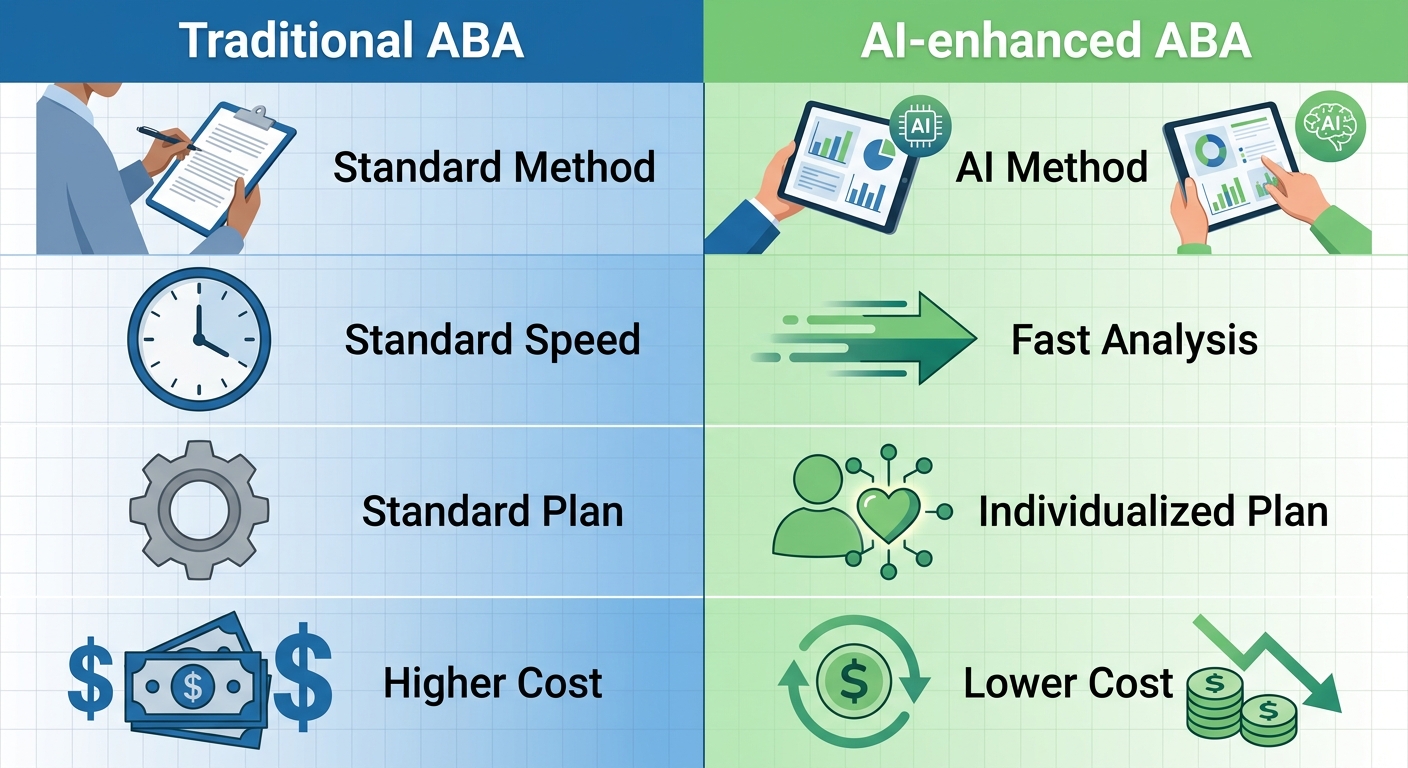
Traditional versus AI-enhanced ABA data collection comparison
This data-driven approach directly supports personalization. Instead of relying solely on therapists’ past observations or parent reports, we fine-tune programs based on a child’s unique response history. For instance, if data shows a child responds best to a certain type of praise at 10 a.m., we can tailor that moment. It’s important to note that AI does not replace the therapeutic relationship; it amplifies our ability to deliver compassionate, child-led care. At All About ABA, we are always exploring ways to make therapy more efficient and effective while keeping your child’s joy at the center.
While the benefits are clear, adopting AI does involve an upfront investment in software and training. However, many providers find that these costs are offset by long-term savings, as therapists spend less time on paperwork and more time interacting with children. These tools also complement telehealth ABA therapy, where remote sensors can track behavior and deliver data to clinicians miles away.
With these core concepts in mind, it’s easy to see how AI can enhance—not replace—the heart of ABA. We’re proud to bring these advanced approaches to families in Arizona, Georgia, Indiana, New Jersey, and North Carolina.
How AI is Transforming ABA Therapy for Children with Autism
One of the most exciting developments in ABA is the integration of artificial intelligence. AI in ABA therapy is reshaping how we support children with autism, turning data into personalized action. At All About ABA, We’re All About You — your child’s unique progress drives everything we do. From clinic-based sessions to the in-home ABA therapy children receive, AI tools make real-time, data-driven adjustments simpler than ever.
The table below summarizes the main AI tools reshaping ABA therapy.
| AI Tool | Application in ABA | Example | Evidence Level |
|---|---|---|---|
| Predictive Analytics | Forecasting skill acquisition and behavior trends | Model predicts a child will reach a communication milestone within 2 weeks based on session data | Moderate – growing research in autism settings |
| Natural Language Processing | Analyzing vocalizations, syntax, and functional communication | Tool flags speech pattern progress during telehealth sessions | Low to moderate – promising early studies |
| Computer Vision | Automated behavior tracking via video analysis | Camera system tracks on-task behavior and self-stimulatory actions | Exploratory – limited real-world ABA studies |
| Machine Learning Models | Identifying patterns across multiple clients for program refinement | Algorithm suggests optimal reinforcement schedule based on history | Moderate – used in research, translating to practice |
Practical Applications of AI Tools in ABA Therapy
How Predictive Analytics Shapes Personalized ABA Plans
Every child’s learning path is unique, and predictive analytics helps us map it with precision. By analyzing historical session data — correct and incorrect responses, engagement duration, and skill-mastery sequences — we can forecast when a child is likely to meet a goal. For instance, a model may predict that your child will master requesting within two weeks, allowing our BCBAs to fine-tune interventions proactively. According to the National Center for Biotechnology Information (NCBI), the evidence base for predictive analytics in autism settings is moderate, with a growing body of research supporting its use. We use these models not to replace clinical judgment but to sharpen it, keeping your child’s progress at the center of every decision.
Natural Language Processing for Communication Skill Development
For children who are non-verbal or minimally verbal, natural language processing opens new doors. Speech-to-text tools and intent-recognition software analyze vocalizations, syntax, and functional communication in real time. In a telehealth ABA therapy session, an NLP engine can flag emerging speech patterns — such as a clearer request or a new word approximation — so our therapists can reinforce those moments immediately. NCBI research currently rates the evidence for NLP in ABA as low to moderate, with promising early studies paving the way. By seamlessly integrating these tools into our sessions, we give your child’s communication skills the extra attention they deserve, in clinic and at home.
Computer Vision and Behavior Observation
Computer vision is part of the latest aba trends, offering a way to capture behavior objectively without constant manual recording. Cameras can automatically track on-task engagement, stereotypy, and social initiations, producing a rich video-based record of each session. This frees up our therapists to focus on meaningful interaction rather than paperwork. The NCBI categorizes the evidence for computer vision in ABA as exploratory, with limited real-world studies so far. Still, we see its potential to reduce human error and bring even more precision to how we celebrate your child’s wins — large and small.
As these AI tools evolve, they are becoming essential components of modern ABA practice — especially when paired with your family’s unwavering involvement.
Selecting AI-Enhanced ABA Tools for Your Child
As AI in ABA therapy becomes more common, choosing the right tool starts with a clear checklist. At All About ABA, we focus on three essentials: evidence base – look for research-backed or clinically validated tools; parent-friendly design, meaning intuitive portals that deliver real-time updates; and deep therapist involvement, so our BCBAs can customize goals and review data seamlessly. Leading platforms now combine session recording analysis and parent portal updates to give you immediate insights. We also look for features that adapt in real time to your child’s pace, keeping therapy dynamic and engaging.
We’re All About You, and Your Family matters, so we carefully select AI tools that support our child-led, naturalistic approach, ensuring technology enhances – never replaces – the therapeutic bond. For families in Georgia, including those who need ABA therapy services in Athens, Georgia, as well as Arizona, Indiana, New Jersey, and North Carolina, our local presence ensures integrated solutions are always accessible in your child’s familiar environment. That way, every session remains tailored to their unique strengths.
Integrating Telehealth ABA Therapy with AI Support
Many families now rely on telehealth aba therapy to maintain consistency when in-person sessions aren’t possible. Integrating AI makes these remote sessions even more effective. Our platform automatically analyzes recorded sessions to track engagement and skill acquisition, then generates concise summary notes for our therapists, saving planning time without missing details. Parents receive daily progress snapshots via our app, including clear visual charts of skill acquisition, so you’re always informed without needing technical expertise.
A real-world example: if our telehealth platform detects that your child has mastered a target behavior, it flags the milestone instantly, and the therapist adjusts goals during the same session. Because AI continuously monitors patterns, this immediate analysis and adaptation brings the same continuity to remote care as in-center visits. This real-time feedback loop ensures that your child’s plan stays aligned with their current abilities, reducing delays and helping progress never stall.
Data-Driven Decision Making in Everyday Sessions
Imagine a typical in-home session: our therapist works one-on-one with your child while a tablet captures response patterns in real time. Suddenly, an AI-powered alert suggests reducing the prompt level because independence is emerging. The therapist adapts immediately, refining the intervention on the spot. Afterward, the system compiles a visual progress snapshot and sends it to your phone, so you can see exactly which targets were met and where growth is happening.
Simultaneously, the AI detects that a long-standing goal has been achieved, auto-updates the treatment plan, and recommends a new objective, which our BCBA approves from the clinic. This eliminates administrative lag and turns data into same-day action. Embedding AI-driven feedback transforms routine data collection into a dynamic partnership between our team, the technology, and your family, keeping therapy nimble and aligned with your child’s unique journey.
The table below highlights how AI-assisted methods can enhance everyday ABA tasks compared to traditional manual approaches. By automating routine tasks like behavior tracking and report generation, families experience faster insights and more personalized care.
| Capability | Manual Approach | AI-Assisted Approach |
|---|---|---|
| Behavior Tracking | Therapist takes notes during or after session; prone to gaps | Automated via wearables, video, or voice input with real-time logging |
| Goal Setting | Based on periodic assessments and team discussions every 6 months | Suggestions updated continuously from data trends; easier to pivot |
| Progress Reports | Compiled manually by BCBA from notes and graphs | AI generates draft reports with data visualizations; clinician finalizes |
| Parent Communication | Email/phone summaries, often delayed | Real-time dashboards and automated daily updates via app |
From behavior tracking to parent communication, the shift from manual to AI-assisted workflows means more timely, accurate information for every family. Instead of waiting for quarterly reports, you get daily snapshots; instead of static goals, your child’s plan evolves with their progress. This seamless flow of data keeps everyone on the same page, making every intervention count. To see how these integrated tools can support your child’s journey, contact us – we’re here for your family.
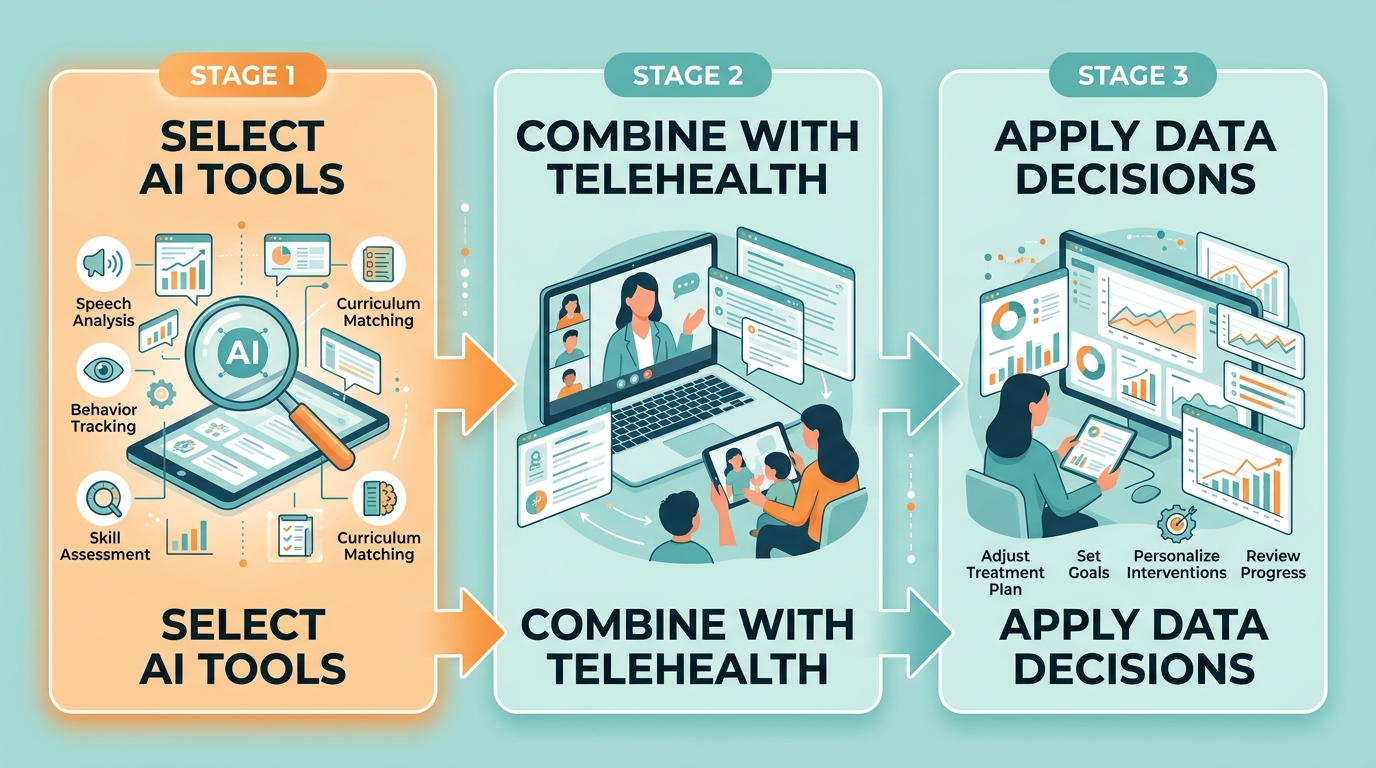
Three-step process for applying AI tools in ABA therapy
Advanced AI Technologies and Emerging Research in Autism Therapy
The role of AI in ABA therapy is rapidly evolving, and at All About ABA, we are excited about the possibilities emerging research brings to autism care. While naturalistic, child-led therapy remains the heart of our approach, we keep a close eye on technology trends that could one day enhance personalization and data-driven decision-making.
To help families understand where these technologies stand today, the table below compares four key innovations in terms of maturity, research support, and accessibility for providers and families.
| Technology | Maturity | Research Support | Accessibility |
|---|---|---|---|
| Generative AI for Report Writing | Emerging | Limited – mostly pilot studies and early adoption | Low – requires careful clinician oversight |
| Wearable Sensors for Real-Time Tracking | Growing | Moderate – increasing number of peer-reviewed articles | Medium – cost and device management barriers |
| Machine Learning – Behavior Prediction | Established in research, early in practice | Moderate to high – solid evidence for pattern detection | Medium – requires data infrastructure and trained staff |
| Virtual Reality with AI Integration | Experimental/early stage | Low – few studies in ABA-specific contexts | Low – expensive and specialized hardware needed |
These ABA trends reflect a broader shift toward data-driven, tech-enhanced care in autism services. Here’s a closer look at each technology:
- Generative AI for report writing is still emerging, with only pilot studies backing its use, and it requires careful clinician oversight.
- Wearable sensors are growing and could support telehealth ABA therapy by capturing data remotely, but cost and device management remain barriers for many families.
- Machine learning, a subset of AI in ABA therapy, has solid research support, yet practical use requires data infrastructure and trained staff.
- Virtual reality with AI integration is very early-stage, with few studies in ABA contexts and high hardware costs limiting accessibility.
Echoing the guidance from Hashtag ABA, we believe that technology should enhance—not replace—the caring, individualized attention that drives real progress. We’ll continue to follow these developments while staying grounded in the proven, human-centered therapy that delivers results. We’re all about you and your family, and we believe the most important factor in your child’s progress is the caring, data-informed partnership between your therapist and your loved ones.
Frequently Asked Questions About AI in ABA Therapy
What is AI in ABA therapy?
AI in ABA therapy uses machine learning and data tools to help us personalize treatment. We view it as a supportive assistant that enhances progress tracking, never a replacement for the compassionate care your child receives.
How is AI currently used in ABA?
AI tools can analyze behavioral data quickly, helping our Board-Certified Behavior Analysts adjust strategies in real time. This aligns with broader ABA trends toward data-driven, personalized care while always keeping the therapist-child connection at the forefront.
Can AI help with telehealth ABA therapy?
Absolutely. AI-enhanced platforms can support real-time data sharing and remote supervision, expanding access to services. In telehealth ABA therapy, these tools help us maintain the same connected, collaborative care that families rely on, even from a distance.
Embracing the Future of AI in ABA Therapy
As we look ahead, the same child-led, results-driven principles guide how we embrace the future of AI in ABA therapy. AI in ABA therapy offers powerful ways to enhance data collection, track progress, and personalize care, but it remains an assistive tool that will never replace the human connection. AI-driven insights help us refine our naturalistic approach, building on the foundation of local, expert care we describe in our resource on finding expert behavioral therapy near you. By thoughtfully integrating technology, we stay aligned with ABA trends while exploring telehealth ABA therapy to reach more families, all without losing the personal touch that defines our programs. Start Your Child’s Journey with a team that blends innovation and heart.


