Table of Contents
What Does Low Functioning Autism Mean?
When a child receives a diagnosis on the autism spectrum, some families hear the term low functioning autism. While this phrase is not a formal medical diagnosis, it is often used to describe individuals who require very substantial support in daily life. The term low functioning autism is sometimes used interchangeably with severe autism or Level 3 autism, which is the clinical classification in the DSM-5 defined by the U.S. National Library of Medicine as requiring very substantial support.
Children described this way often face significant challenges, including severe impairments in verbal and nonverbal communication, intellectual disability, and intense repetitive behaviors. These characteristics mean a child may be minimally verbal and rely heavily on caregivers for basic needs, safety, and navigating their environment. We recognize that labels can feel overwhelming, but we focus on each child's unique strengths and potential for growth.
Understanding these support needs helps us tailor effective, child-led ABA therapy. As All About ABA, we are here to support your family every step of the way on your child’s journey, using a compassionate approach that builds communication and daily living skills. For families seeking immediate guidance, exploring how we provide ABA therapy for kids near me can be a positive first step. We’re All About You, Your Family, and Your Child, and we create a warm and supportive space where every need is heard and every step is taken with care — because your journey matters.
Defining Severe Autism and Level 3 Classification
Low functioning autism, now clinically termed Level 3 autism, represents the most significant support needs on the autism spectrum. As an outdated label, it has been replaced by the DSM-5 classification system, which describes autism through three distinct support levels. We believe that understanding these classifications helps families navigate their child's diagnosis with clarity and confidence. The American Psychiatric Association's framework gives us a shared language to discuss the intensity of support a person requires, moving away from subjective terms like 'severe autism' toward a more precise, needs-based model.
The clinical picture of Level 3 autism is defined by pervasive challenges across communication, social interaction, and behavioral flexibility. Individuals at this level require very substantial support in their daily lives. In the DSM-5 classification, communication for severe autism (Level 3) is characterized as minimal or no functional speech. This means a person may use very few words intelligibly, rely on alternative communication methods, or not speak at all. Socially, the presentation includes very limited social initiation or response to others. A person may seem unaware of social bids from peers or caregivers, rarely making eye contact or engaging in the back-and-forth rhythm of interaction that typically developing children do. Perhaps most distinctively, the repetitive and restrictive behaviors seen at this level manifest as extreme distress at change and intense fixations. Even small deviations from a routine can cause overwhelming anxiety, and interests may be deeply entrenched, making it difficult to transition to new activities or focus on anything outside those fixations.
To put Level 3 in perspective, it’s helpful to view it alongside the other two levels. The following table offers a clear side-by-side comparison of how these characteristics manifest across the spectrum.
| Characteristic | Level 1 (High Functioning) | Level 2 | Level 3 (Severe / Low Functioning) |
|---|---|---|---|
| Communication | Fluent speech with social cue challenges | Limited speech or repetitive language | Minimal or no functional speech |
| Social Interaction | Difficulty with back-and-forth conversation | Marked deficits; responds only to direct approaches | Very limited social initiation or response |
| Repetitive Behaviors | Inflexible behavior, interferes occasionally | Repetitive behavior noticeable to casual observer | Extreme distress at change, intense fixations |
| Support Required | Requires support | Requires substantial support | Requires very substantial support |
This comparison highlights the substantial support needs that define Level 3, in contrast to Level 1, where individuals require support but communicate fluently, and Level 2, where deficits are marked but some functional communication remains. The autism support levels in the DSM-5 classification are designed to capture the degree of assistance a person needs, not to place a value on their potential. According to the National Institutes of Health, this scale reflects the severity of core autism symptoms and the intensity of intervention required.
It is important to remember that autism is a spectrum, and an individual's profile can vary across domains. However, a Level 3 classification indicates a pervasive need for very substantial support in nearly all settings. While 'low functioning autism' is not a clinical term and is often considered outdated, Level 3 is the correct diagnostic descriptor for what many refer to as severe autism. At All About ABA, we see this diagnosis not as a limit, but as a guide for creating a truly personalized, results-driven, child-led therapy plan. Given the very substantial support required for severe autism (Level 3), a naturalistic, intensive, and compassionate intervention becomes critical.
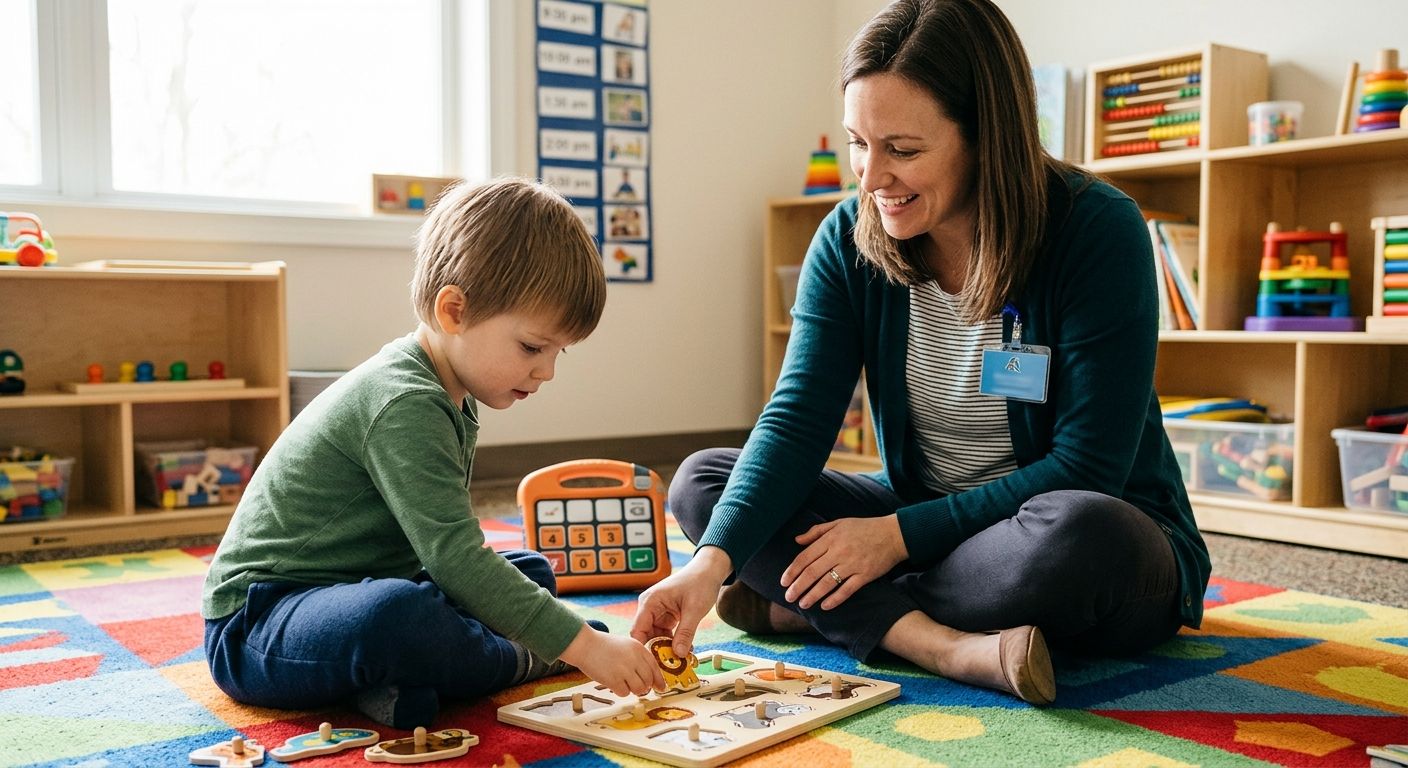
ABA therapist providing child-led therapy to a child with low functioning autism
Visual guide to autism severity classification
Seeing the levels laid out visually can make the distinctions between them more concrete for families who are just beginning their journey. When we start with a clear understanding of a child's needs, we can build a treatment plan that focuses on functional communication, flexibility, and meaningful social engagement, always honoring the child's individual starting point. This foundation is what allows us to move forward with purpose into the specific strategies and therapies that can make a profound difference.
Key Differences Between High and Low Functioning Autism
Understanding the autism spectrum means recognizing the wide range of abilities and challenges individuals may experience. The terms "high functioning" and "low functioning autism" represent the opposite ends of this spectrum, specifically aligning with Level 1 and Level 3 in the DSM-5 framework. By comparing these two profiles, we can better understand the distinct support needs and intervention strategies that help each individual thrive.
Understanding the Autism Spectrum: From Level 1 to Level 3
The DSM-5 outlines three levels of autism spectrum disorder, each defined by the amount of support an individual requires in daily life. Level 1, often referred to as high functioning, describes individuals who need some support to navigate social and organizational challenges. Level 2 indicates a need for substantial support, with more noticeable difficulties in verbal and nonverbal communication. At the far end of the spectrum, Level 3 aligns with what many call severe autism (Level 3). Individuals with Level 3 autism require very substantial support due to severe deficits in communication and extreme difficulty coping with change. According to government research data from the National Center for Biotechnology Information (NCBI), this level frequently co-occurs with intellectual disability and highly limited verbal abilities. Recognizing these levels helps families and clinicians identify the appropriate intensity of intervention.
Communication and Social Interaction Differences
The contrast in communication between Level 1 and Level 3 is one of the most defining characteristics. Individuals with high functioning autism (Level 1) typically develop spoken language and may have extensive vocabularies, but they often struggle with the pragmatic, or social, use of language. They might miss nonverbal cues, have trouble maintaining back-and-forth conversations, or interpret language very literally. In low functioning autism, the picture is quite different. These individuals may have little or no verbal speech and rely heavily on augmentative and alternative communication methods, such as picture exchange systems or speech-generating devices. Social motivation also varies greatly. While someone with Level 1 autism may be interested in forming friendships but lack the skills to do so, an individual with Level 3 autism often shows little or no interest in peer interaction, focusing instead on solitary activities.
Behavioral Patterns and Support Needs
Both groups may engage in repetitive behaviors and experience sensory sensitivities, but the intensity and impact on daily life differ dramatically. For a person with high functioning autism, these behaviors might appear as strong, narrow interests or a rigid preference for routine. In individuals with low functioning autism, repetitive motor mannerisms like hand-flapping or rocking can be far more pronounced and difficult to redirect. Sensory over or under-reactivity can also lead to extreme distress or, conversely, a high tolerance for pain. The need for supervision is a critical differentiator. A person with Level 3 autism often requires constant, one-on-one supervision to ensure safety, as they may not recognize common dangers in their environment.
The following table summarizes the key contrasts across various domains, with data backed by NCBI research on language ability and cognitive differences.
| Aspect | High Functioning Autism (Level 1) | Low Functioning Autism (Level 3) |
|---|---|---|
| Language Ability | Develops spoken language; may be verbose | Limited or absent verbal speech |
| Social Motivation | Interested in peers but struggles with nuances | Little or no interest in peer interaction |
| Cognitive Ability | Often average or above-average IQ | Frequently co-occurs with intellectual disability |
| Daily Living Skills | May need support with complex tasks | Needs help with basic self-care activities |
| Intervention Approach | Often benefits from social skills groups and counseling | Intensive one-on-one ABA therapy is often essential |
How ABA Therapy Addresses These Differences
At All About ABA, we know that therapy must be as unique as the individual receiving it. When working with individuals who require very substantial support, our results-driven, child-led ABA therapy can be customized for all support levels. Our ABA therapy for children spring from a philosophy that meets a child where they are, using their natural interests to motivate learning. For those with level 3 autism, this form of naturalistic therapy is intensive and one-on-one, concentrating on foundational skills that dramatically improve quality of life. We focus on teaching functional communication, such as learning to request a favorite item or a break, which can significantly reduce frustration and severe challenging behaviors. As outlined in our core principles, we also work extensively on tolerating transitions and building flexibility, helping to ease the extreme distress that change can cause. By integrating parent coaching, we ensure these strategies extend beyond sessions, creating a consistent and supportive environment. Understanding these differences helps families and therapists choose the right approach for lasting, meaningful progress.
Can Low Functioning Autism Improve? The Role of ABA Therapy
If your child has been diagnosed with level 3 autism, you may wonder whether real improvement is possible. The short answer is yes—especially with early, intensive ABA therapy. At All About ABA, we have seen that while progress varies for every child, consistent, evidence-based intervention can lead to meaningful gains in communication, behavior, and independence for children with low functioning autism. Our approach focuses on building foundational skills through positivity and play, creating a path toward a brighter, more connected future for your whole family.
Early Intervention and Developmental Progress
We understand that an early diagnosis can feel overwhelming, but it also opens the door to the most impactful window for change. Research and our own clinical experience confirm that early intervention, ideally before the age of five, can lead to the most significant developmental leaps for children with low functioning autism. This is a period of incredible neuroplasticity, where the brain is most adaptable and responsive to learning. By starting ABA therapy early, we can systematically target core deficits in communication and adaptive behavior. Families in Spring seeking ABA therapy for children spring have access to programs that harness this critical developmental period. Rather than waiting for a child to fall further behind, we proactively teach the skills needed to connect with others and navigate daily life, laying a strong foundation for all future learning.
Naturalistic ABA: Building Communication and Life Skills
Gone are the days when ABA therapy meant sitting at a table doing repetitive drills. We create a warm and supportive space where every need is heard and every step is taken with care—because your journey matters. For children with severe autism, our results-driven, naturalistic, child-led therapy is often the most effective path to building communication and life skills. This approach follows the child’s lead, using their natural interests and play as the context for teaching. For instance, if a child loves a spinning top, we use it to teach requesting, turn-taking, or labeling colors. The goal is generalization, ensuring that a child who learns to say 'more' during a game of chase also says 'more' when they want a snack at the kitchen table. The following table outlines the specific, evidence-based approaches we integrate to build a comprehensive program.
| Aspect | High Functioning (Level 1) | Low Functioning (Level 3) |
|---|---|---|
| Language Ability | Develops spoken language; may be verbose | Limited or absent verbal speech |
| Social Motivation | Interested in peers but struggles with nuances | Little or no interest in peer interaction |
| Cognitive Ability | Often average or above-average IQ | Frequently co-occurs with intellectual disability |
| Daily Living Skills | May need support with complex tasks | Needs help with basic self-care activities |
| Intervention Approach | Often benefits from social skills groups and counseling | Intensive one-on-one ABA therapy is often essential |
Each of these approaches plays a distinct role in your child’s program. Discrete Trial Training is excellent for breaking down a complex task, like washing hands, into a series of teachable units, using clear repetition and positive reinforcement. In contrast, Pivotal Response Training focuses on 'pivotal' areas like a child’s motivation to interact, which can spark widespread improvements across many other skills. Our skilled clinicians expertly blend these techniques—using a DTT approach to teach a new concept and immediately shifting to a NET session to practice that skill while playing with a favorite toy, making learning both effective and joyful.
Family Involvement and Parent Coaching
Our commitment to your child’s progress extends far beyond our one-on-one therapy sessions. We believe that a child’s journey with level 3 autism is a family journey, and empowerment comes through partnership. Parent coaching is a non-negotiable core component of our program, not an add-on. We dedicate time to training you—the parents and caregivers—in the same behavior-analytic techniques we use. This transforms daily routines, from breakfast to bath time, into powerful opportunities for learning and reinforcement. A child who is learning to communicate a need for a break at the clinic will have that crucial ability flourish only if parents are equipped to recognize and reinforce the attempt at home. Your involvement helps your child generalize skills, reduces challenging behaviors across settings, and rebuilds a sense of shared joy and confidence in your family unit.
Celebrating Milestones and Setting Realistic Expectations
Progress in ABA therapy is a series of beautiful, hard-won victories, and we believe in celebrating every single one. We work closely with you to set realistic expectations that honor your child’s unique path, understanding that no therapy offers a guarantee of a cure. For a child with low functioning autism, success might look like making eye contact during a favorite song, tolerating a family meal without distress, or initiating a request for a hug for the very first time. These are monumental achievements that represent genuine, lasting change in your child’s quality of life and your family’s happiness. By tracking these specific, meaningful milestones—from a first word to a calmer morning routine—we can visibly map the journey of progress, maintaining hope and momentum. As a parent, your greatest reward will be in these shared smiles and first moments, a testament to the collaborative work you’ve invested.
Navigating Daily Life with Severe Autism
Understanding a diagnosis of low functioning autism, clinically referred to as level 3 autism, is the first step for many families. The daily reality of life with severe autism involves navigating unique challenges in communication, behavior, and safety that can feel overwhelming. At All About ABA, we believe that creating a predictable, supportive environment is key to helping your child and your entire family thrive. We’re All About You, Your Family, and Your Child, and we are here to guide you through building a manageable and joyful daily life.
For a child with low functioning autism, the world can be an unpredictable and overstimulating place. Establishing a clear, predictable routine is often the most powerful tool for reducing anxiety and challenging behaviors. Using a visual schedule with pictures or objects can help a non-verbal child understand what to expect next, from mealtimes to therapy sessions. Integrating communication tools like the Picture Exchange Communication System (PECS) or simple AAC devices throughout the day gives your child a voice to express their needs, which is crucial for reducing frustration. Addressing safety is also paramount, as wandering, or elopement, is a serious concern. Simple home modifications like high locks, door alarms, and clear family protocols can create a more secure environment, allowing you to focus on connection and learning. These supportive strategies are not guaranteed solutions but practical tools that can empower your family and provide a foundation for progress.
Finding the right structured support is a critical component of daily life for individuals diagnosed with level 3 autism. Different therapeutic settings offer unique benefits that can complement your efforts at home, helping to generalize skills to new environments. The table below outlines key support options, each designed to integrate seamlessly into your child’s life and promote functional independence.
The following table compares support options for children with severe autism:
| Support Option | Setting | Key Benefit | Considerations |
|---|---|---|---|
| In-Home ABA Therapy | Home | Natural environment for skill practice | Requires space and active family engagement |
| Center-Based ABA | Clinic | Structured environment with peer opportunities | May require transportation and scheduling coordination |
| Community-Based Training | Public places (parks, stores, etc.) | Generalization of skills to real-world contexts | Requires extra planning and flexibility |
| School-Based Support | School | Consistency of support throughout the school day | Needs strong collaboration with school staff |
Our passionate clinical team tailors our results-driven, child-led therapy to fit these exact settings, working with you to determine the best approach for your child. By blending these options, we can create a comprehensive support system that promotes first moments and family smiles everywhere, from your living room to a community park in Arizona, Georgia, or beyond. You don’t have to navigate this journey alone. Contact us for a personalized plan and Start Your Child’s Journey with a team that truly cares.
Frequently Asked Questions About Low Functioning Autism
What is low functioning autism?
Low functioning autism, also called severe autism or level 3 autism, means a person needs very substantial support with daily living, communication, and behavior. These individuals often face significant challenges that require intensive, personalized care from both families and professional support teams.
Can ABA therapy help children with severe autism?
ABA therapy breaks down complex skills into small, manageable steps and uses positive reinforcement to encourage progress, which can be especially effective for those with level 3 autism. This individualized approach often helps children build communication and daily living skills at their own pace, and may support greater independence over time.
What are the main characteristics of level 3 autism?
Children with level 3 autism often have limited verbal communication, may engage in repetitive behaviors, and typically require extensive assistance with everyday tasks. Our child-led, naturalistic therapy approach creates a warm and supportive space where every need is heard and every step is taken with care — because your journey matters. We're here to support your journey every step of the way.
Empowering Families on the Journey Ahead
Walking this path together, we understand that families of children with low functioning autism need more than clinical care. We create a warm and supportive space where every need is heard and every step is taken with care – because your journey matters. Our family guidance support helps you feel confident navigating life with severe autism.
You are the expert on your child, and we bring deep experience with level 3 autism. With the right support, families thrive. We’re All About You, Your Family, and Your Child.