


Table of Contents
Understanding Your Therapy Options for Autism
The Importance of Choosing the Right Therapy
When considering aba therapy vs developmental therapy, many families find a child-led, naturalistic ABA approach, incorporating developmental principles,offers the most effective path. We’re All About You, guiding families in Arizona, Georgia, Indiana, New Jersey, and North Carolina to that personal solution.
A Modern Look at ABA and Developmental Therapies
According to the CDC's recommendation, evidence-based ABA now includes the Early Start Denver Model (ESDM), a play-based approach for children 12–48 months that integrates developmental goals directly into treatment sessions.
Child-Led Therapy: A Progressive Evolution
Child-led, naturalistic ABA follows a child’s interests and play, building skills through everyday interactions instead of repetitive drills. At All About ABA, we tailor each session to your child’s motivations, making learning enjoyable and embedded in real-life contexts.
What You'll Learn in This Guide
This tutorial takes a look at how ABA works in comparison to other developmental therapy methods, and answers frequently asked questions about mixing them together. It will also help you choose which is right for your child.
The Fundamentals of ABA and Developmental Approaches
When parents look for ways to treat their child with autism, they often come across two types of therapy, ABA therapy and developmental therapy.
What Is ABA Therapy?
Classical approaches include discrete trial training, where there is more structure to the lesson as well as one-on-one instruction. Modern ABA focuses more on naturalistic, play-based methods such as pivotal response training (PRT), and natural environment teaching (NET), which embeds the lessons in everyday activities and follows the interests of the child. At All About ABA, we take a personal approach, using what we learned from the assessment to create a personalized treatment plan. We also train parents on how they can incorporate their child’s program at home and in community environments.
Understanding Developmental Therapy
Developmental therapy aims to support emotional connection and child initiative utilizing play as primary means of helping your child learn how to communicate and be involved in their world. Play is used as the main medium to promote communication and social engagement. DIR/Floortime is an approach that encourages therapists to play with kids following their leads and interests. This is another way to build relationship. ESDM (Early Start Denver Model), recognized by the Centers for Disease Control and Prevention (CDC) for children aged 12–48 months, integrates behavioral and developmental strategies through play.
Where ABA and Developmental Approaches Meet
While ABA has relied on structured, discrete trials in the past, developmental therapy focused more on child-led play. However, they have some things in common now. Both approaches base their strategies on assessment and data analysis. We blend child-directed techniques with structure and play for a balance between the two traditional approaches.
ABA Therapy vs Developmental Therapy: Feature-by-Feature Comparison
The CDC says that when you compare ABA therapy vs developmental therapy, there’s more proof that supports Applied Behavior Analysis in treating autism spectrum disorder (ASD), and no medicine can treat its underlying symptoms.
Which Therapy Best Supports Social-Emotional Growth?
The Early Start Denver Model (ESDM), a developmental approach, explicitly targets social-emotional growth for children ages 12 to 48 months. The right choice depends on your child's needs and your child.
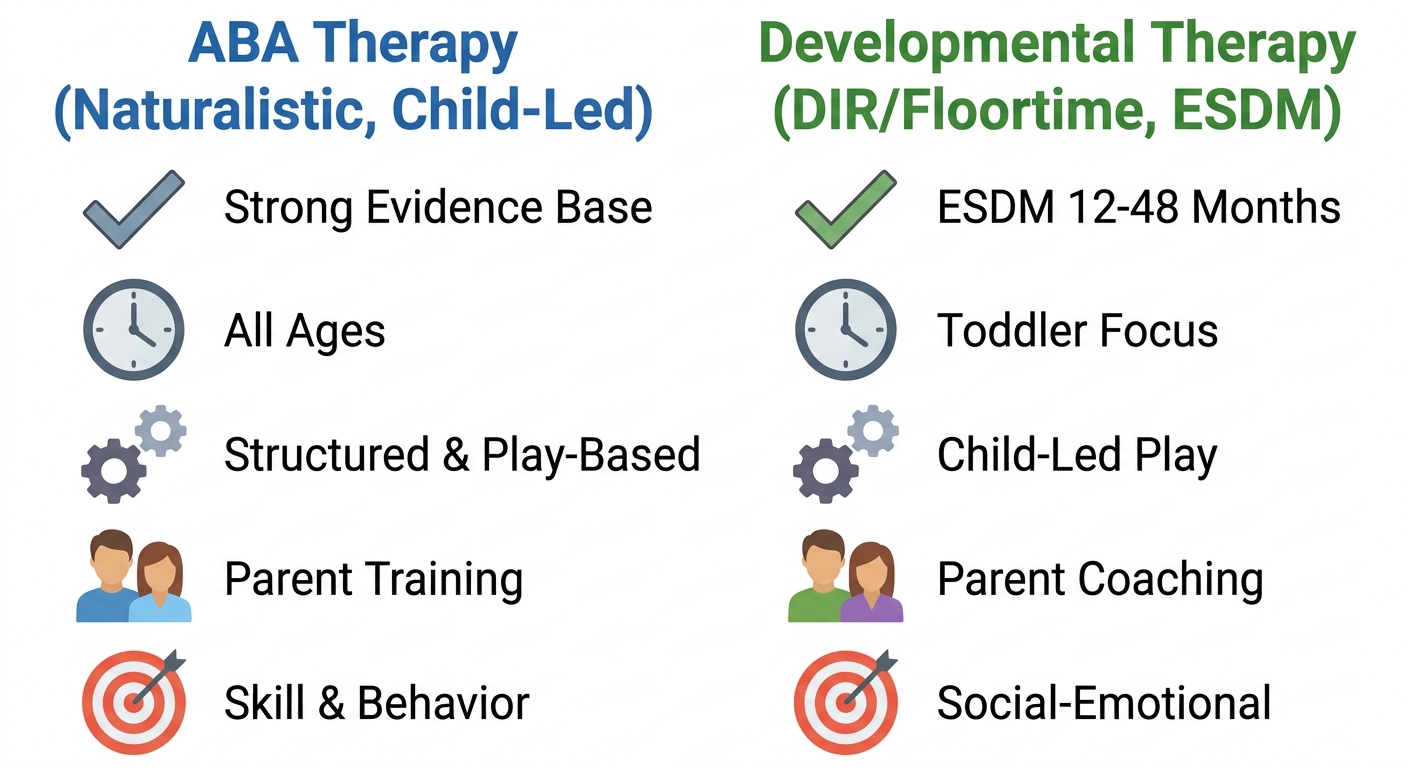
ABA vs Developmental Therapy: feature-by-feature comparison infographic.
ABA vs DIR/Floortime: What the Research Says
All About ABA has a naturalistic, child-led approach that focuses on play-based techniques including PRT (Pivotal Response Treatment) and NET (Natural Environment Teaching).
| Feature | ABA Therapy (Naturalistic, Child-Led) | Developmental Therapy (DIR/Floortime, ESDM) |
|---|---|---|
| Evidence Base | Strongest evidence per CDC | ESDM support for 12–48 months |
| Age Range | All ages | 12–48 months |
| Therapeutic Approach | Structured; naturalistic/play-based | Child-led relational play |
| Parent Involvement | Parent training integral | Parent coaching emphasized |
| Focus Areas | Skill acquisition; behavior reduction | Social-emotional growth; communication |
Making Sense of the Comparison Table
ABA does really well for gaining skills in general as well as reducing negative behaviors, whereas developmental approaches focus more on social-emotional bonding and play-based communication skills. We're trusted by many insurance companies.
Investment in Therapy Options for Autism
What Influences the Cost of Autism Therapy?
The expertise and credentials of a provider, his or her geographic location, how often the sessions happen and whether they are held at the clinic, home or in the community all influence ABA care. In many states, insurance mandates require coverage for ABA treatment, which can substantially lower out-of-pocket expenses. Coverage for developmental therapy varies widely. We will work through your benefits to determine exactly what your plan will cover. This helps you avoid surprises.
Insurance Coverage for ABA and Developmental Therapy
ABA is usually covered by most state autism mandates, which means that many health plans will cover it. While developmental therapies such as DIR Floortime may be considered part of the mental health category, there are variations and separate copayments or deductibles may apply. If a family is considering a blended program, they can save significantly when a single provider is in-network for both services. We will verify your benefits at the initial intake appointment so you can understand your financial options before committing.
Making Therapy Affordable
Our intake team creates a welcoming environment that listens to each client’s needs and gives you information on various insurance plans available. We can help you make informed decisions based on this knowledge.
Making the Right Choice for Your Child's Therapy
A Decision Matrix for Choosing Therapy
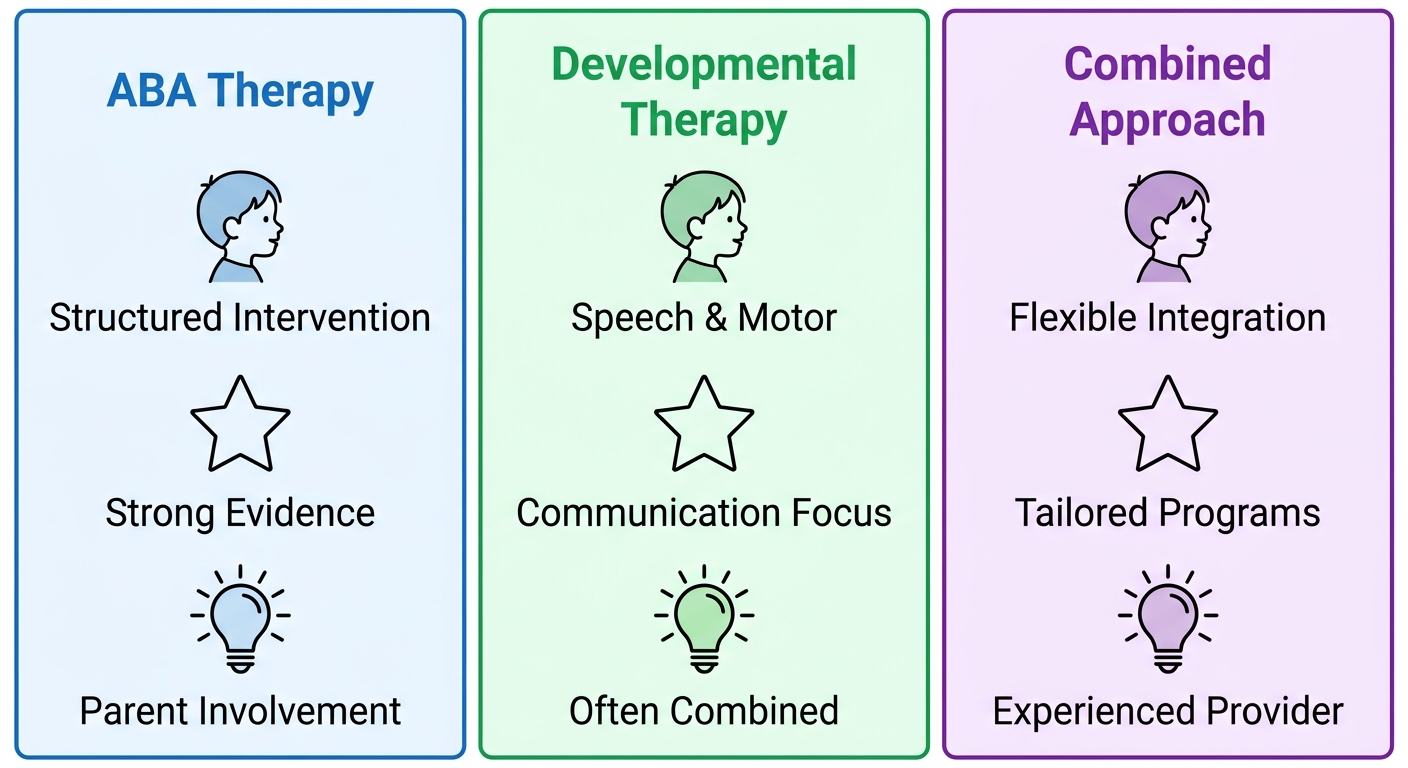
The CDC identifies ABA as the most widely accepted treatment with the strongest evidence. Developmental therapies, including the Early Start Denver Model, target communication and motor skills in children 12–48 months.
| Therapy Type | Best For | Key Benefits | Important Considerations |
|---|---|---|---|
| ABA Therapy | Children who need structured, evidence-based intervention targeting behavior, communication, and daily living | Strongest evidence base (CDC); personalized plans (All About ABA) | Requires parent involvement |
| Developmental Therapy | Children who need speech, motor, and social skill support | Improves communication and motor skills (CDC) | Often used alongside ABA |
| Combined Approach | Children who benefit from both structured and child-led methods | Flexible integration of strategies | Needs providers with experience in both; All About ABA can tailor such a program |
Three Steps to Finding the Right Fit
- Assess your child’s needs.
- Consult professionals.
- Verify insurance coverage.
Tips for Evaluating Therapy Providers
Our team includes BCBAs who blend methodologies such as PRT and NET to create a tailored, results-driven program.
Your Child's Journey with Evidence-Based Therapy
Understanding the difference between ABA therapy vs developmental therapy can be the first step in making an informed decision.
Understanding the Two Approaches
Nowadays, ABA now blends approaches such as the Early Start Denver Model or Pivotal Response Training.
Beginning Your Child's Therapy Journey
We check your coverage for health insurance as well as carry out a complete medical analysis in order to tailor a personalized treatment plan according to your child's strengths and hobbies.
Partnering with Experienced Professionals
Our passionate clinical team partners with your family to deliver compassionate, results-driven care in our clinics across Arizona, Georgia, Indiana, New Jersey, and North Carolina. Reach us at (844) 525-5226.
Choose the Best of Both Worlds
Now that you have explored ABA and developmental therapy side by side, you see that a blended, naturalistic approach can deliver the most complete support. We offer a child-led, play-based ABA model that combines evidence-based structure with developmental, relational methods, drawing on the strengths of both worlds. Our personalized treatment plans target communication, social engagement, and daily living skills while keeping family harmony at the center. With over 64 five-star reviews, parents consistently trust our compassionate, results-driven care. We make starting therapy straightforward: we first verify your insurance benefits, then conduct a detailed evaluation to design a program uniquely tailored to your child. Services are available across Arizona, Georgia, Indiana, New Jersey, and North Carolina, with flexible clinic and in-home options. You have learned why a combined strategy matters, now take the next step by reaching out to discuss your child’s specific needs. Let us partner with you in a supportive, child-led environment where your child can truly thrive.
Choose the Best of Both Worlds


