Table of Contents
Discrete Trial Training in ABA Therapy
One of the most common and effective techniques we use in ABA is Discrete Trial Training (DTT). This highly structured, evidence-based method breaks down complex skills into small, teachable steps, making it ideal for introducing foundational abilities, such as labeling objects or imitating actions. This process is a core component of the behavioral therapy we provide.
A discrete trial follows a simple three-part sequence. First, our therapist presents a clear instruction, like "Touch the red car." Then, the child responds. Finally, a meaningful consequence follows immediately—your child receives enthusiastic praise or a preferred toy for a correct answer, or gentle guidance to try again. Our RBTs are trained to implement this precise method with warmth, integrating elements of verbal behavior therapy to promote language development. DTT is most often used in 1:1 therapy sessions and has strong research support for building critical skills for early learners. We’re All About You, Your Family, and Your Child, using every session to build confidence step by step.
Getting Ready for DTT Sessions
Now that you understand the structure of DTT, let's look at how to prepare for a successful session. Discrete trial training (DTT) is a structured form of behavioral therapy that requires careful preparation. At All About ABA, we believe that the steps you take before a child's first trial set the stage for meaningful progress.
Our therapists focus on creating a calm, focused environment so each child can learn comfortably. Here's how we prepare for effective sessions:
- Set up the space: Choose a quiet area with minimal distractions. A small table and two chairs work perfectly, with all materials stored within easy reach.
- Gather your materials: Have your data sheets, a pen, and the child's preferred reinforcers ready. Also, prepare any stimulus cards or objects needed for the day's targets.
- Check motivation: Conduct a quick, two-minute preference assessment before you begin. This confirms which toys, activities, or treats are most motivating for the child right now.
- Review the plan: The therapist, often an RBT providing rbt therapy, reviews the program from the BCBA. They then prepare the discriminative stimuli in the correct order for teaching.
- Build rapport: Start by greeting the child warmly with a smile. Spend a moment in a preferred play activity, and only present the first trial once they are calm and attentive.
This thoughtful preparation, rooted in techniques from verbal behavior therapy, honors each child's need for individualization. With your session space ready, you're all set to run the first trial.
Setting Up the Teaching Environment
We know a structured environment is essential for effective discrete trial training. Now that you understand the basics, let’s focus on creating a warm and supportive space right in your home where every learning moment counts. A consistent setup reduces distractions and helps your child feel ready to engage.
Choose a quiet corner or room with minimal foot traffic and noise. Position a small table so you and your child can sit face-to-face, fostering connection during DTT sessions. Keep a basket nearby with essential materials: preferred reinforcers, stimulus cards, a simple timer, and a token board to track wins. Many RBT therapy techniques rely on quick access to these tools to keep the session flowing naturally.
Plan short bursts of 5–10 minutes followed by movement breaks to maintain focus. Rotate reinforcers based on your child’s shifting interests, and weave verbal behavior strategies into playful interactions. When you prepare the space ahead of time, you step fully into your role as a partner in the process—ready to celebrate every small success together.
Choosing the Right Skills and Targets
After understanding what ABA therapy is, the next step is choosing the right skills and targets for your child. We know every child is unique, so we never take a one-size-fits-all approach. Instead, our clinical team works with your family to identify goals that reflect assessment results and your priorities.
We create a warm and supportive space where every need is heard and every step is taken with care – because your journey matters. Targets can include communication, social skills, daily living, play, and adaptive behaviors, all chosen based on what is meaningful for your child. For communication goals, targets may follow a verbal behavior therapy framework. As ABA Hashtag clarifies, ABA is not restricted to autism; it supports diverse skill areas and needs.
Your input as a parent is essential. Through rbt therapy, we then help bring these targets to life with consistent practice. Once the right skills and targets are identified, we can use evidence-based methods like discrete trial training to teach them.
Delivering Clear Instructions and Prompts
Before exploring how to deliver clear instructions, it helps to revisit the ABA therapy meaning to understand the foundation of our approach. At All About ABA, we believe instruction delivery is at the heart of every successful learning moment. We create a warm and supportive space where every need is heard, and every step is taken with care—because your journey matters.
Clear instructions must be concise, age-appropriate, and tied directly to the target behavior. During discrete trial training, our RBT therapists follow the supervising BCBA’s treatment plan exactly to ensure consistency. We use prompt hierarchies like least-to-most (starting with a subtle gesture and increasing support only if needed) and most-to-least (providing full physical guidance initially, then fading it quickly) to minimize errors while protecting client dignity.
In verbal behavior therapy, a clear instruction paired with a well-timed model—such as demonstrating the mand “more”—sets the stage for a correct communication response. Prompt fading is essential to avoid dependency, and we systematically reduce assistance as your child gains independence. With clear instructions in place, we can move to data collection.
Providing Effective Reinforcement
In discrete trial training, effective reinforcement means strategically delivering a preferred consequence to increase the likelihood that a targeted behavior will recur. We prioritize child-led, naturalistic reinforcers so learning stays meaningful and motivating.
In practice, we use differential reinforcement—giving stronger, immediate reinforcement for correct responses and smaller or delayed reinforcement for approximations—to shape new skills. During early acquisition we start with continuous reinforcement, then shift to intermittent schedules to maintain behavior over time. Natural reinforcers like specific praise, access to favorite activities, or brief play keep sessions child-centered. To prevent satiation we rotate reinforcers and keep trials short and engaging. In our model, technicians applying reinforcement during rbt therapy work under clinical supervision to promote independence. Similarly, verbal behavior therapy relies on reinforcement to teach mands and tacts within systematic discrete trial training procedures.
Once reinforcement is effectively in place, we can layer in prompts and fading strategies to support skill acquisition and generalization across settings.
Collecting and Recording Trial Data
In discrete trial training, collecting accurate trial-by-trial data is essential for tracking progress and adjusting our therapy plans. During each session, we record the learner’s response as correct or incorrect immediately after every trial, noting the prompt level used — whether it was a full physical prompt, a partial gestural cue, or an independent correct answer.
We also rely on probe data, like cold probes, to check skill mastery without prompts. According to the National Center for Biotechnology Information (NCBI), the behavior analysis research database offers authoritative guidelines and templates for standardizing data collection methods in applied behavior analysis.
Many therapists use paper data sheets alongside digital tracking tools — both approaches work well when used consistently in RBT therapy. Precise recording directly informs every treatment decision we make, ensuring interventions stay responsive and effective.
Finally, the data we gather during sessions supports collaboration during parent guidance, helping families see measurable progress. Whether for discrete trial instruction or verbal behavior therapy, this careful documentation keeps our child-led programs aligned with ethical standards and your child’s unique goals.
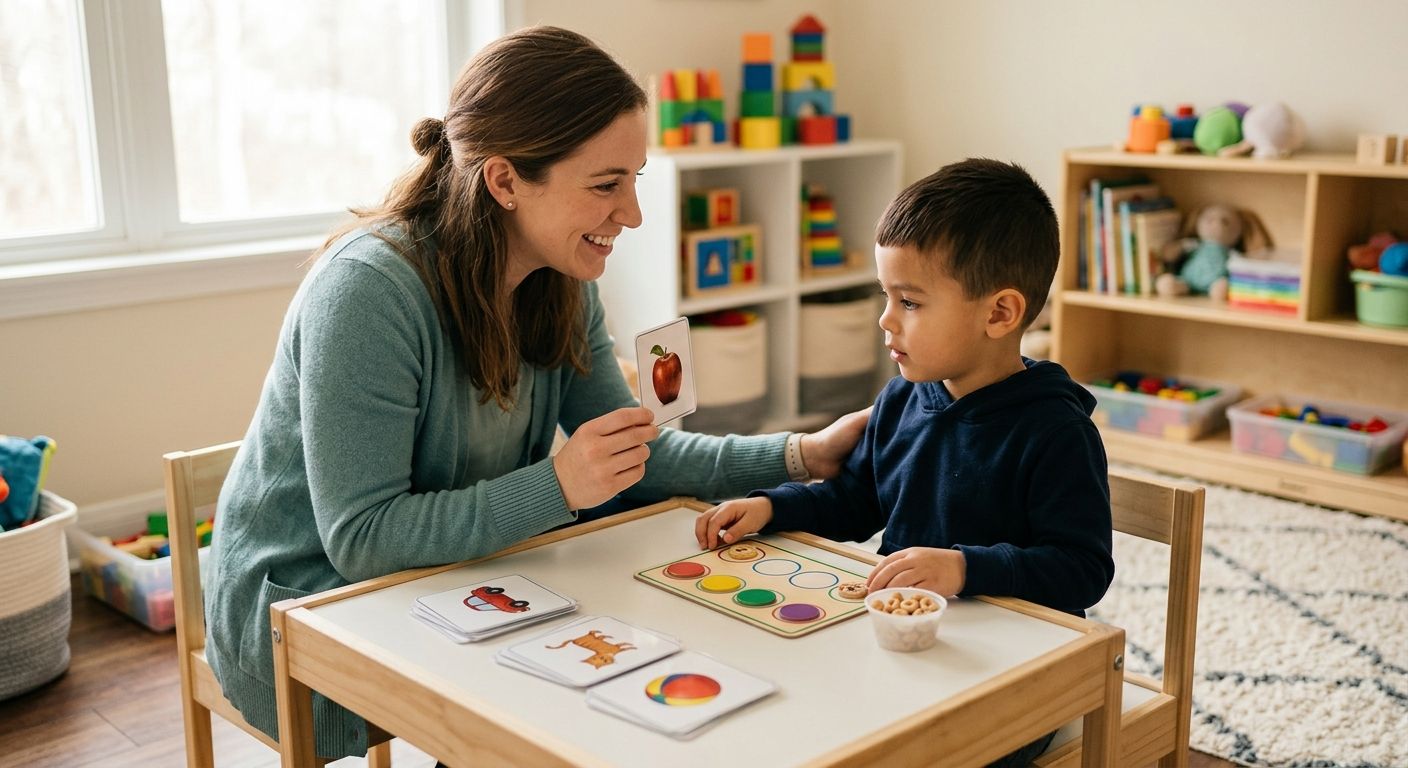
Engaging Discrete Trial Training session in ABA therapy
Data collection process for discrete trial training in ABA therapy
Mixing Maintenance and Acquisition Trials
While discrete trial training (DTT) often uses massed trials of the same skill, an effective program also incorporates mixing maintenance and acquisition trials. Maintenance trials involve presenting skills your child has already mastered to promote long-term retention and fluency. Acquisition trials introduce new skills for the first time.
In our therapy, we blend these trial types to create a positive, balanced learning experience. A helpful parent guide from the ABA Hashtag Blog notes that a typical ratio of 80% maintenance to 20% acquisition keeps learners engaged and reduces frustration. Because most of the session focuses on what your child already knows, they experience more success, which builds confidence and motivation. This child-led, naturalistic approach aligns with our results-driven philosophy and may be a part of your child’s RBT sessions. We also incorporate DTT and verbal behavior therapy techniques to reinforce communication goals.
By mixing mastered and new skills, we prepare your child for more naturalistic teaching in the everyday environment, supporting generalization of learning.
Generalizing Learned Skills
While discrete trial training builds foundational skills in structured settings, true success comes when a child uses those skills in everyday life. Generalization means transferring what is learned in therapy to real-world situations—like a child who practices requesting a snack with a picture card during a session and then does the same at home with a parent. This transfer isn't automatic; it must be intentionally taught. We work alongside families, practicing skills across different people, materials, and settings. Our RBTs (Registered Behavior Technicians) collaborate closely with caregivers to embed practice into daily routines, from mealtime requests to greetings at the park. Techniques from verbal behavior therapy, such as mands and tacts, are specifically designed to help children communicate functionally wherever they are. By weaving skill-building into natural, child-led moments, we help your child’s progress become meaningful and lasting.
Common Challenges in Discrete Trial Training
Some of the most common challenges in discrete trial training (DTT) include maintaining a child’s engagement, ensuring accurate data collection, promoting skill generalization, and supporting staff fidelity. While DTT is a proven teaching method, these implementation hurdles can affect progress when not addressed proactively.
One of the most common challenges in discrete trial training is maintaining a child’s engagement during repetitive massed-trial sessions. Children may lose interest, making it hard to complete trials. Research from the National Center for Biotechnology Information suggests that building child choice and preferred activities into the routine can help sustain attention, reminding us that even highly structured programs benefit from flexibility.
Another frequent challenge in discrete trial training is data collection reliability. When RBTs are recording data under time pressure during RBT-led therapy sessions, inconsistencies can creep in. The Behavior Analyst Certification Board ethics code underscores the importance of accurate measurement, requiring ongoing supervision to monitor and correct recording practices.
Generalization presents a distinct obstacle: a skill mastered in a DTT session may not automatically transfer to natural settings without explicit programming. The Association for Behavior Analysis International highlights strategies such as multiple exemplar training and natural environment teaching to bridge the gap. Our results-driven, naturalistic, child-led therapy approach incorporates these generalization tactics from the earliest planning stages, and verbal behavior therapy techniques can complement these efforts by reinforcing language in everyday contexts.
Staff fidelity to the DTT protocol can vary, especially among newly certified RBTs. Without consistent training and oversight, subtle deviations from the intervention plan may undermine outcomes. To support consistent implementation, RBTs and supervising BCBAs can consult BACB certification resources for the latest ethics and supervision guidelines. We create a warm and supportive space where every challenge is approached with evidence-based strategies so that families and practitioners can move forward confidently.
We know these challenges are real, but fortunately, resources from the Behavior Analyst Certification Board, the Association for Behavior Analysis International, and leading research databases like the National Center for Biotechnology Information provide a solid foundation for overcoming them.
Embracing Discrete Trial Training for Meaningful Progress
At All About ABA, we embrace discrete trial training (DTT) as a structured, evidence-based teaching method that breaks complex skills into small, repeated steps with clear prompts and reinforcement. This gentle approach is woven into our results-driven, naturalistic, child-led therapy, creating a warm and supportive space where every child can thrive.
Our RBTs implement discrete trial training under BCBA supervision, focusing on foundational skills like imitation, labeling, and requesting. Within a verbal behavior therapy framework, DTT targets verbal operants such as mands and tacts, building communication that generalizes to everyday moments. These structured trials are a tool within a larger, individualized plan, never a rigid drill, and our team ensures each session remains playful and child-led. This ensures every child’s progress is both meaningful and sustainable.
Our methods are aligned with professional standards from ABAI behavior analysis resources and the Behavior Analyst Certification Board, ensuring your child receives high-quality care. This structured foundation sets the stage for skills to flourish in everyday moments, Promoting First Moments and Family Smiles Everywhere.