Table of Contents
The Power of Play in ABA Therapy
Because every child learns differently, we tailor our approach – and one of the most powerful tools is play. Play based aba therapy transforms learning into a natural, engaging experience. When a child is fully absorbed in a favorite game, they are more motivated to communicate, share, and problem-solve. This makes ABA therapy for children fun and effective, turning everyday moments into opportunities for growth.
In our sessions, we follow your child’s lead, weaving skill-building into the activities they love. During pretend play with a toy kitchen, a therapist might encourage turn-taking and labeling foods, building play based aba social skills like waiting and responding to a peer. When rolling a car back and forth, the child practices joint attention and requesting the next turn. These natural interactions create a low-pressure environment where learning feels like play, not work – a hallmark of our child-led naturalistic therapy.
Beyond social skills, play opens doors for communication. A child reaching for a bubble wand learns to vocalize or gesture, creating natural opportunities for aba therapy speech development. Similarly, handling a pause in a game or sharing a favorite toy helps build emotional regulation. This is why our therapists design play based aba therapy sessions around your child’s unique strengths, turning every session into a warm, supportive space where your child can thrive and make results-driven progress. The power of play isn’t just about fun – it’s about building skills that last. Let’s explore how we design play experiences around your child’s unique strengths.
Understanding Play-Based ABA Therapy
Having explored the foundations of ABA therapy, we can now focus on a more naturalistic approach: play-based ABA. According to Hashtag.org ABA Resources, ABA therapy is a scientifically validated method that helps children build communication, social, and daily living skills by reinforcing positive behaviors. Play based aba therapy takes these principles and weaves them into the activities your child already loves, making learning feel like play rather than work. This child-led style contrasts with traditional table-top drills, shifting the focus from repetitive trials to engaging, real-world interactions that follow your child’s lead.
To see the differences clearly, here is a comparison of traditional and play-based ABA:
| Aspect | Traditional ABA | Play-Based ABA |
|---|---|---|
| Session format | Structured table-top drills, repeated trials | Natural play activities, child-initiated |
| Reinforcement | External rewards (food, tokens, stickers) | Intrinsic reinforcement from play; social and sensory rewards |
| Generalization | Often practiced in isolated settings, may require separate generalization steps | Built into natural environment, skills transfer more readily to daily life |
| Child motivation | Relies on adult-selected tasks and rewards | Driven by the child’s interests; higher engagement and autonomy |
Choosing between these approaches isn’t about one being better—it’s about what fits your child best. While traditional ABA can be helpful for learning specific skills in a structured way, play-based ABA taps into your child’s natural curiosity and motivation. Because skills are practiced during activities that your child truly enjoys, they tend to stick and apply more easily to everyday life. This naturalistic approach also makes sessions feel uplifting and pressure-free, which helps build a positive association with therapy.
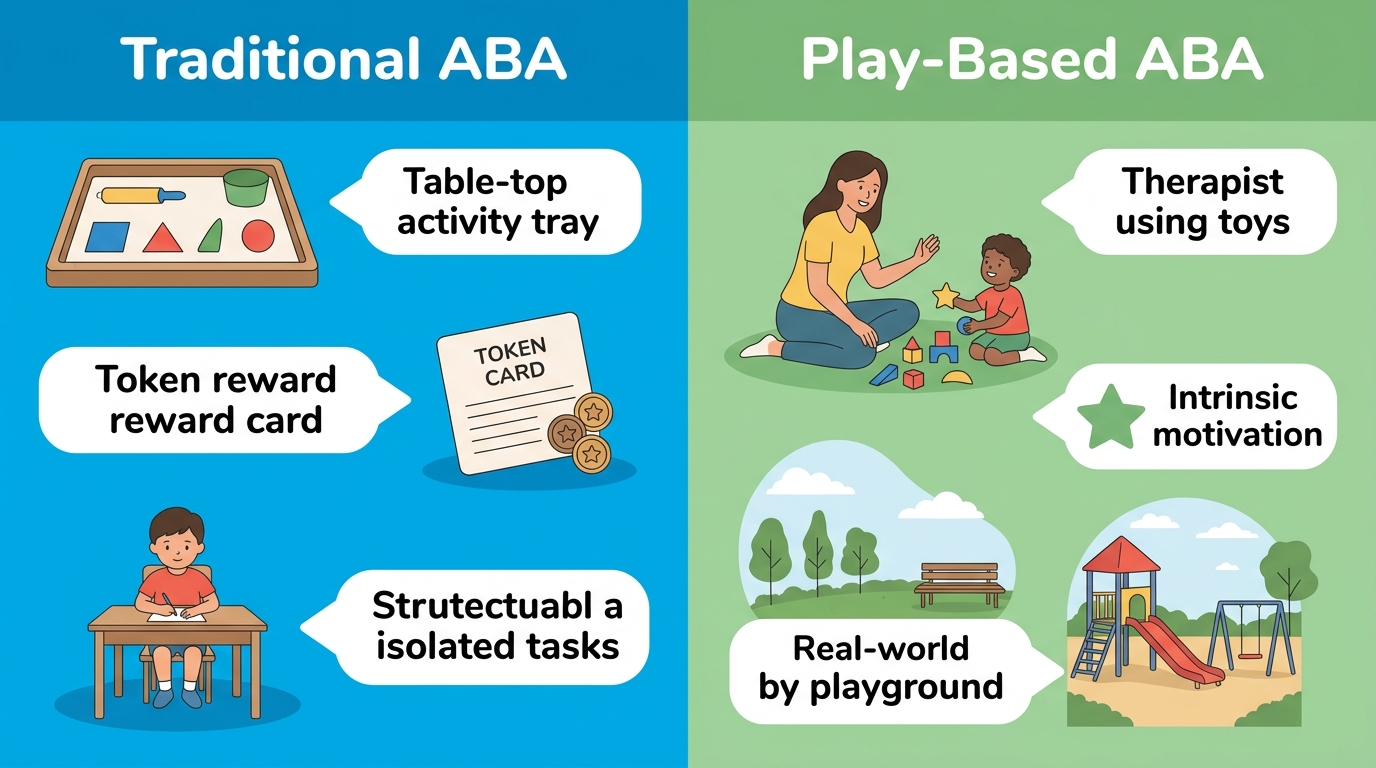
Visual comparison of traditional versus play-based ABA therapy methods
We create a warm and supportive space where every need is heard, because your journey matters. Play-based ABA offers many of the same benefits of ABA therapy for kids, such as improved communication and social skills, while keeping your child engaged through play. By embedding goals into favorite games, we target aba therapy speech development when your child asks for a toy or narrates a pretend scenario, and we strengthen play based aba social skills through turn-taking and shared enjoyment with siblings or peers. Because learning happens in real-life contexts, these gains generalize far beyond the therapy room. Our play based aba therapy programs are tailored to your child’s unique interests and goals, bringing meaningful progress right where it counts, at home and in the community. Understanding how play-based ABA works sets the stage for seeing its real-world impact on your child’s development, and our team in Scottsdale, AZ, Charlotte, NC, and across our service areas is ready to support your family.
How Play-Based ABA Therapy Supports Skill Development
Building on the foundations of naturalistic play, play based aba therapy helps children build communication, social, and cognitive skills in a fun, pressure-free environment. Our therapists, who meet BCBA certification requirements, design child-led sessions that use your little one’s favorite toys and activities to create motivation for learning. Three evidence-based play-based ABA techniques are commonly used:
| Technique | Core Focus | Best For | Typical Setting |
|---|---|---|---|
| Pivotal Response Training (PRT) | Motivation, self-initiation, responsivity to multiple cues | Improving social communication, play skills, and behavioral flexibility | One-on-one play sessions at home or clinic |
| Natural Environment Teaching (NET) | Generalization of skills across real-world contexts | Transferring learned behaviors to everyday routines | Home, community, school, clinic play areas |
| Early Start Denver Model (ESDM) | Naturalistic developmental behavioral intervention (NDBI) | Young children (12–48 months) with autism; building foundational skills | Clinic-based with parent coaching; can be adapted for home |
At All About ABA, we blend elements of PRT, NET, and ESDM to create individualized programs that feel like guided play. This approach ensures that every session is results-driven while remaining warm and engaging, meeting Your Family and Your Child exactly where they are.
Speech and Language Development Through Play
Our approach to aba therapy speech development centers on capturing natural communication moments as they happen. When your child reaches for a favorite toy, we might model the word “ball” or “car,” turning a simple request into a powerful learning opportunity. Through playful interactions, we help children expand their vocabulary, improve sentence structure, and use language to comment, protest, or ask questions—all without formal drills. Because the motivation comes from the child’s own interests, new words tend to stick. This means your child learns to request favorite toys, describe actions, and eventually engage in back-and-forth conversation in a way that feels effortless and joyful.
Social Skills and Peer Interaction
Our play based aba social skills sessions teach turn-taking, joint attention, sharing, and initiating peer interaction through activities that feel like fun, not therapy. During a simple game of catch or a pretend tea party, we guide children to look at their play partner, wait for a turn, and respond to social cues. Over time, these repeated, playful exchanges help children connect more comfortably with siblings and peers. We create a warm and supportive space where every need is heard and every step is taken with care—because your journey matters. This means your child can build friendships and navigate group settings with growing confidence, learning to interact in ways that feel natural and rewarding.
Cognitive and Adaptive Skill Growth
In play based aba therapy, puzzle-solving and pretend play become powerful tools for building executive functions like planning, flexibility, and problem-solving. For example, when your child figures out how to fit puzzle pieces together or decides which role each toy will take in a make-believe scenario, they are practicing cognitive skills that transfer to daily life. Our child-led naturalistic therapy embeds these challenges within routines such as cleaning up toys or following a simple recipe, turning everyday moments into opportunities for adaptive growth. This means your child gradually learns to organize tasks, adapt to changes, and solve problems independently—skills that support greater independence at home, at school, and in the community.
Finding and Choosing Play-Based ABA Therapy Providers
Now that you understand how play based aba therapy uses naturalistic, child-led methods to build meaningful skills, the next step is finding a provider who truly brings those principles to life. If you're ready to find ABA therapy providers, start by identifying programs that clearly emphasize child-led, play-centered approaches. The table below outlines key factors families can evaluate when comparing options.
| Factor | What to Look For | Questions to Ask |
|---|---|---|
| Provider credentials and team composition | Board Certified Behavior Analysts (BCBAs) on staff; ongoing supervision | Are your BCBAs on-site during sessions? What is their caseload? |
| Play-based approach | Use of naturalistic strategies such as PRT, NET, or ESDM | What specific play-based methods do you use? How are sessions structured? |
| Parent involvement and training | Regular parent coaching; caregiver goals integrated into the plan | How do you involve parents in sessions? What training do you offer? |
| Setting and generalization | Services available in clinic, home, and community | Where do sessions take place? How do you help skills transfer to daily life? |
At All About ABA, we provide multi-setting play-based therapy across Arizona, Georgia, Indiana, New Jersey, and North Carolina, reflecting the coordinated approach many families seek. Use this table as a reference as you explore the steps below.
Evaluating Provider Expertise and Program Fit
Verifying clinical credentials is a crucial first step. You can confirm a provider’s Board Certified Behavior Analyst (BCBA) certification directly through the Behavior Analyst Certification Board’s online registry — a step we always recommend before scheduling a consultation. Look for programs that prominently feature naturalistic, play-based strategies like Natural Environment Teaching (NET), Pivotal Response Training (PRT), or the Early Start Denver Model (ESDM) in their materials. These methods ensure therapy stays engaging and child-led rather than drill-based.
Beyond credentials, ask about on-site supervision. We believe that regular, direct oversight by a BCBA makes a meaningful difference, so find out what percentage of session time a BCBA is present and actively supervising. A lower caseload often signals more individualized attention and better fidelity to the child’s plan. Additionally, confirm that the provider has experience working with children similar to yours in age and communication level — this shapes how naturally they can weave speech and social goals into playful interactions. At All About ABA, our results-driven, naturalistic, child-led therapy is built on these foundations, and we encourage every family to ask for a clear explanation of how the program adapts to their child’s unique strengths.
Key Questions to Ask During Provider Consultations
Preparing a list of thoughtful questions helps you gauge whether a program truly aligns with your family’s goals. Consider bringing the following prompts to your next consultation:
- What play-based methods (such as NET, PRT, or ESDM) do you use, and can you walk me through what a typical session looks like?
- How do you track my child’s progress toward speech and communication milestones? How is aba therapy speech development specifically addressed through play?
- Can you describe how you foster play based aba social skills and peer interaction within sessions?
- How frequently do parents participate in coaching or training, and how are our goals documented in the treatment plan?
- Can you give a concrete example of how you’ve helped a child generalize a skill from the clinic to home or the community?
- How do you coordinate with other professionals, such as speech or occupational therapists, to ensure a unified approach?
- What experience does your team have with children at my child’s age and communication level?
These questions open conversations about session structure, child-led activities, data tracking, and family collaboration. Pay attention to how naturally the provider explains their approach — if you leave with more confusion than clarity, that may be a sign to keep looking. We create a warm and supportive space where every need is heard and every step is taken with care, and we believe you deserve the same from any team you consider.
Building a Coordinated Play-Based Plan
The most effective therapy bridges clinic, home, and community settings so skills transfer seamlessly into daily life. Start by asking prospective providers if they offer services across multiple environments and how they integrate parent training into those settings. A strong plan includes specific, measurable caregiver goals — not just child-focused objectives — so that you can reinforce learning during everyday moments.
We design our programs to include parent coaching as a core feature, because when families practice strategies consistently, progress accelerates. If your child receives speech or occupational therapy, confirm that the ABA team actively communicates with those providers to align goals. This collaboration ensures that skills like requesting, turn-taking, and following routines are practiced similarly across all environments.
Finally, trust your instincts. A provider who cannot clearly articulate their play-based model or involve you as an equal partner may not be the best fit. Once you’ve found a team that feels right, the next section will guide you through maximizing your child’s progress through consistent routines and ongoing family involvement.
Advanced Techniques in Play-Based ABA Therapy
Building on the core principles of child-led therapy, advanced techniques in play-based ABA therapy push skill development to a deeper level. As ABA Hashtag notes, ABA therapy’s evidence-based framework supports not just autism but also other behavioral challenges, reinforcing the versatility of our play-centered approach. In our sessions, we move beyond simple play to deliver measurable, family-centered outcomes.
Natural Environment Teaching (NET) is central to our advanced work. During a typical session, our therapists embed learning goals directly into ongoing play activities. For example, while your child is engaged in a favorite pretend play scenario, we might prompt them to request a specific toy using a word or gesture. This child-led, naturalistic method ensures that communication skills are practiced in moments that feel fun and meaningful.
Another cornerstone is incidental teaching. We design the environment to create opportunities for your child to initiate an interaction, then seize those moments to expand their learning. If your child reaches for a puzzle piece, our therapist might encourage them to say “puzzle” or ask “can I have it?” This approach leverages your child’s own motivation to build language and social engagement spontaneously.
When it comes to ABA therapy speech development, we incorporate preferred toys and activities to model sounds, words, or phrases within play. For instance, while playing with a toy farm, we might make animal sounds or label the animals, encouraging your child to imitate. This is how we seamlessly integrate speech goals into our play-based ABA therapy sessions.
Similarly, our focus on play-based ABA social skills uses peer interactions to foster turn-taking and joint attention. In a group session, a child engaging in parallel play next to a peer may be gently guided to share a toy or take turns rolling a ball. This natural progression from side-by-side play to cooperative interaction forms the foundation of friendship.
Pivotal Response Treatment (PRT) is another research-backed, play-driven therapy model we use. It targets pivotal areas like motivation and self-initiation, empowering your child to become an active participant in learning. Throughout all these techniques, family involvement is essential; we coach parents to reinforce skills at home, ensuring progress extends beyond therapy sessions. At All About ABA, our passionate clinical team delivers these advanced interventions across multiple locations, and we accept many insurance plans to make child-led therapy accessible to families. Ultimately, these methods show how learning through play can build lasting skills that pave the way for meaningful progress.
Common Questions About Play-Based ABA Therapy
Here are answers to common questions parents ask us.
What is play-based ABA therapy?
In play-based ABA therapy, children learn communication, social, and daily living skills through child-led, natural play. We embed learning into fun activities that follow your child’s interests and spark natural growth.
How does play-based ABA help with social skills?
We target play-based ABA social skills through activities that teach turn-taking, sharing, and joint attention during preferred play, making gains feel effortless.
Can play-based ABA support speech development?
Absolutely. By embedding ABA therapy speech development in motivating play, we encourage vocal requests and conversation—games and songs spark communication naturally and help children find their voice.
We create a warm and supportive space where every need is heard and every step is taken with care - because your journey matters. We're here for you.
Starting Your Child's Journey with Play-Based ABA
Start Your Child’s Journey with play based aba therapy at All About ABA, where daily play becomes a path to new skills. Our child-led, naturalistic approach uses activities like stacking blocks or sensory exploration to nurture communication, social abilities, and independence in a warm, supportive setting.
The first step is a personalized intake and assessment at one of our welcoming centers across Arizona, Georgia, and beyond. Following research-backed, positive reinforcement methods from Hashtag.org, we design an individualized program just for your child. Let’s explore how this journey unfolds.