


Table of Contents
Proactive Foundations for Positive Behavior
Antecedent interventions are intentional environmental modifications used in ABA therapy to reduce challenging behaviors and increase positive engagement before difficulties arise. These proactive strategies focus on adjusting what happens around a child to set the stage for success rather than reacting to behaviors after they occur. According to peer-reviewed research by the U.S. National Library of Medicine, antecedent-based interventions are classified as an evidence-based practice for learners with autism, validating their effectiveness in creating supportive learning environments.
At All About ABA, we incorporate these environmental adjustments into our naturalistic, child-led therapy model because we believe that meaningful progress starts with meeting children where they are. By thoughtfully arranging surroundings, offering choices, and embedding preferred activities into sessions, our clinical team helps children feel comfortable and motivated to participate. This approach aligns seamlessly with our commitment to individualized care that honors each child’s unique needs and strengths.
Applying proactive changes consistently can transform daily routines and therapy sessions into opportunities for growth without unnecessary frustration. We’re All About You, and we know that understanding how these strategies function in practice makes all the difference. Let’s explore how these proactive environmental shifts come to life during ABA sessions.
Understanding Antecedent Interventions in ABA Therapy
Antecedent-based interventions involve taking actions ahead of time that prevent problem behavior and encourage desirable behaviors, and therefore make up part of any effective ABA program.
Defining Antecedent-Based Interventions
An antecedent intervention involves modifying the physical setting, daily activities, or how a task is presented before a behavior has occurred. Antecedent interventions have been identified in the U.S. National Institutes of Health research portfolio as evidence-based practices for children with autism spectrum disorders. Antecedents target potential behavior triggers, such as loud noise, transitioning from one activity to another, or being asked to perform a difficult task, and seek to resolve problems ahead of time. For example, informing a child with ASD about what he will be doing next through the use of pictures, or giving him a snack prior to asking him to complete a task he finds challenging are examples of antecedent interventions. This proactive philosophy is woven into every aspect of effective ABA therapy, reflecting a commitment to supporting a child's success rather than simply reacting to difficulties. The importance of this strategy is reflected in the fundamental role antecedents play in effective ABA treatment programs.
Common Types of Antecedent Strategies
Peer-reviewed research from the National Institutes of Health highlights several practical antecedent strategies that families and therapists can use. Noncontingent access is one of many techniques that families have found useful for working through transitions. Noncontingent access means making available some desired object to a child during transitions. For example, when transitioning out of playtime, you might hand over your child’s favorite stuffed animal just before asking her to go to the table for work. This makes the shift feel more inviting. Offering warnings also helps with transitions. Providing either a visual timer or counting down before each change, or telling children “In about three minutes, we will get dressed for school,” enables them to get ready psychologically for whatever event awaits their arrival, resulting in fewer problems for all concerned. The high probability instructional sequence involves quickly issuing a series of fairly low-risk directives prior to more demanding commands, so children may follow because they succeeded previously at responding to relatively uncomplicated instructions. Rarely are these procedures used separately from other components of comprehensive programs. They are usually combined with functional communication training and visuals to form a full program.
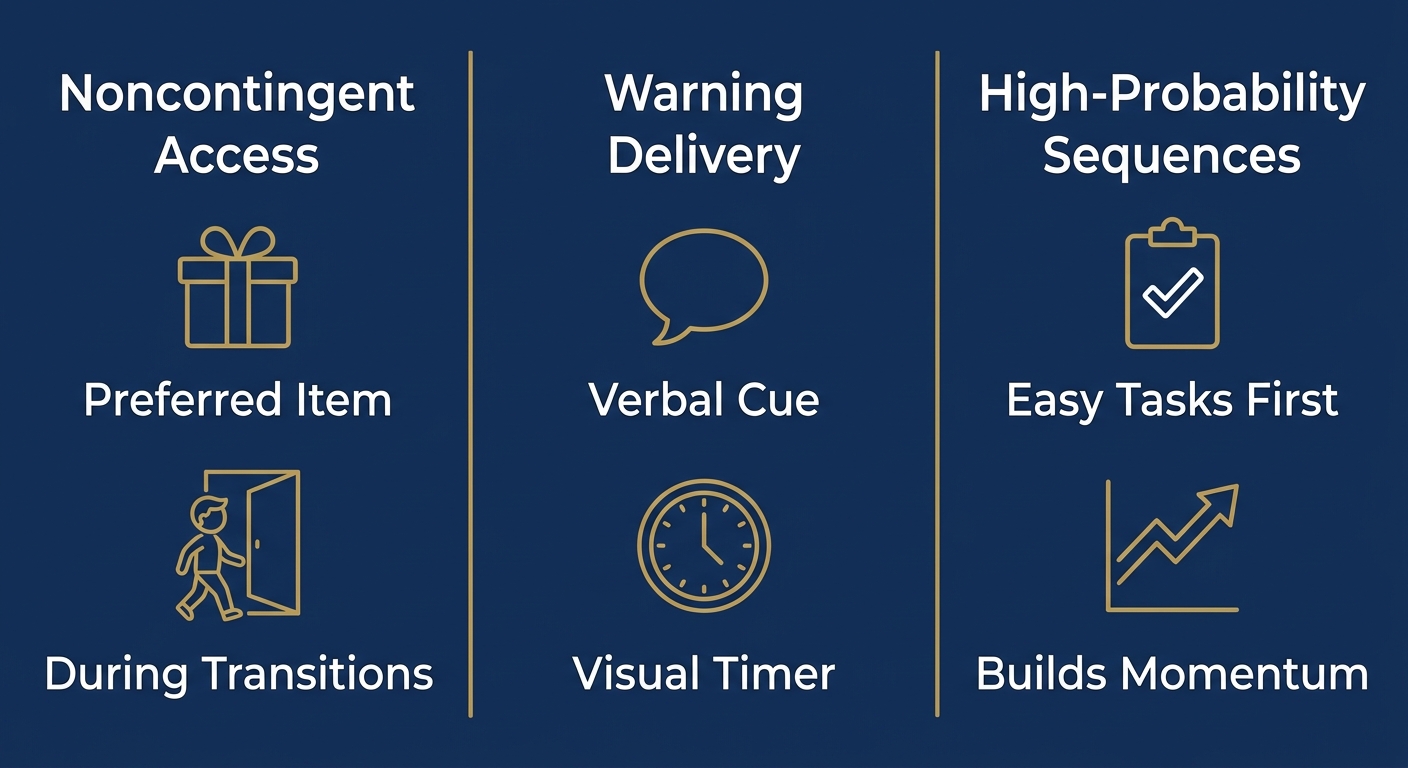
All demonstrate how we can manipulate what goes first in terms of sequence rather than relying on reactive consequences when the act takes place.
The Role of Proactive Changes in Behavior Management
Moving away from reactively addressing behaviors towards taking preemptive steps makes a huge difference in how we respond to challenging behaviors. If we take steps like simplifying tasks, letting the student know what’s happening next, or providing items for comfort, the events which led up to our student refusing or having a meltdown don’t happen anymore. This builds up their trust and confidence because they have less things go wrong for them, which improves their attention span and cooperativeness regardless if we are at home, a clinic, or a classroom. These types of changes become part of the normal routine during aba parenting training sessions and parents can make little changes on their end as well turning regular occurrences into smooth interactions between parent and student.
Integrating Antecedent Interventions into Daily Routines
One way that antecedent-focused interventions can be most effective is in how families and therapists are able to get those procedures embedded as routine parts of kids' day-to-day lives. Our clinical staff works closely with parents to incorporate all aspects of this type of prevention as a standard feature within home environments. This way we build a foundation for appropriate behavior to become more normalized.
Collaborating with Families for Consistent Implementation
Our Board Certified Behavior Analysts (BCBAs) collaborate closely with families to implement antecedent interventions tailored for their daily lives. While not providing blanket protocols to every situation, they evaluate what purpose each undesirable action serves to the child - does he want to access something, or try to avoid doing something difficult. Research published in the Journal of Applied Behavior Analysis confirms that a one-size-fits-all approach often fails; functional analysis is essential to select the right technique. With this knowledge, BCBAs then instruct parents on employing specific antecedent techniques such as offering noncontingent access to a high-interest toy before a nonpreferred task, giving a calm verbal warning before a transition, or starting a session with a series of easy, high-probability requests to build momentum.
Incorporating Positive Reinforcement Alongside Antecedent Strategies
Antecedent modifications can prevent escalation. Antecedent + Positive Reinforcement is the full picture. If a child follows directions in response to an antecedent we like, then we give the child praise, offer a preferred activity, or give a small reward. Evidence based techniques include High Probability Command Sequences, effective instruction, errorless compliance training. When an antecedent is paired with reinforcement, this combination was found most effective in a review of 42 studies. This happens in every plan because kids often need expected behaviors along with a predictable routine and reinforcement when antecedent changes alone are not enough. That being said, just changing antecedents may not be enough.
Training Caregivers: ABA Parent Training Strategies
Empowering parents to become skilled implementers of antecedent interventions is a cornerstone of our program. Our parent training sessions go beyond simple explanations; we model each strategy, watch caregivers practice, and provide supportive feedback until the steps feel natural. Families learn to spot early signs of frustration, adjust the environment to reduce triggers, and use high-probability request sequences during routines like getting dressed, eating meals, or transitioning to bed. Research confirms that caregiver-implemented interventions are highly effective because parents have the most natural opportunities to prompt and reinforce compliance throughout the day. Our BCBAs teach families to break routines into small steps, use visual schedules to increase predictability, and fade prompts gradually so the child responds to naturally occurring cues. This collaborative approach builds on the evidence that antecedent interventions are most effective when caregivers are actively involved.
Implementing Environmental Modifications for Success
By altering the environment in a proactive manner, educators can avoid challenging behavior and help children learn better by changing their physical setting before they have a chance to act up.
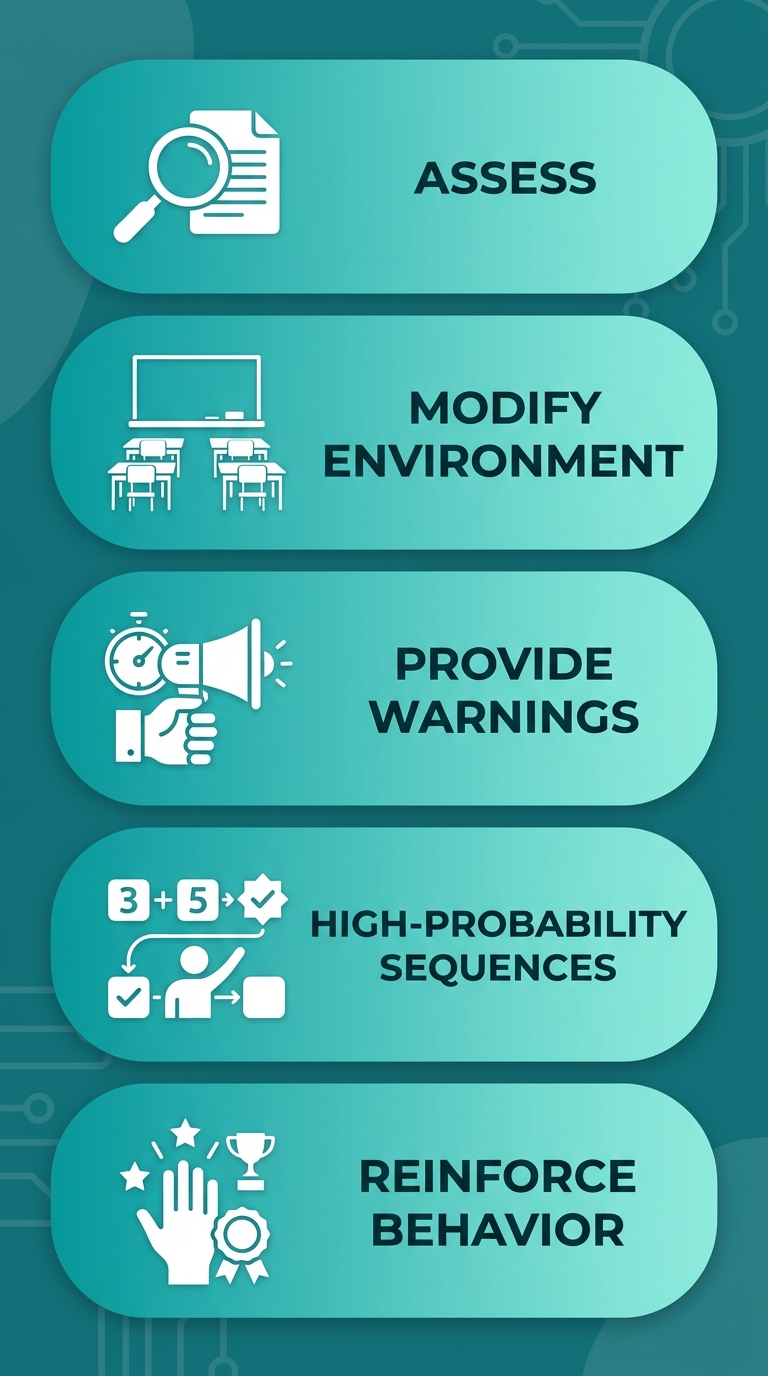
Environmental Arrangement and Instructional Planning
The physical and social environment can be used to set up a situation so the appropriate response will occur as well as to prevent situations where unwanted behaviors may occur in the first place. According to research studies performed at the NIH/PubMed, providing noncontingent access to a preferred toy or activity during transitions can reduce problem behavior and keep a child engaged. For example, allowing a favorite small toy or activity while moving between tasks gives the child a positive focus, making the shift feel predictable rather than threatening. We prepare our classrooms by carefully arranging things like furniture, manipulatives, and routines so that expectations are clear and the physical environment encourages cooperation, reducing the chance of challenging behavior from the start.
Using Warnings and High-Probability Sequences
Giving warnings in advance about what’s going to happen works to help the brain prepare for the upcoming transition, preventing abrupt shifts from routine tasks. Other techniques such as using a high probability instructional sequence is another option. High-probability instructional sequences begin with several easy, mastered requests the child will do willingly before a more difficult instruction. This builds behavioral momentum, much like a runner gaining speed. The National Institutes of Health / PubMed systematic review covering children aged 1 to 19 identified high-probability command sequences and effective instruction delivery as evidence-based strategies that increase the likelihood of appropriate behavior. Using both techniques together allows us to lessen any barrier our kids may be feeling and make cooperation more the norm than the exception. In sum, research found high probability command sequence and other effective instruction delivery were related to improvements in student behavior based upon the publication by the National Institutes of Health & Pubmed, which covered ages 1 to 19 years old.
Tailoring Antecedent Strategies to Individual Needs
Not all antecedent strategies will be right for all children. Therefore, we try to make any modifications based off of a proper FBA, the child's goals, and their specific family dynamic. Research has shown that using a cookie cutter approach in terms of interventions doesn't always work well. What works well for one student, does not necessarily apply to others depending on their underlying motivators. Understanding the purpose behind certain behaviors helps us set up the physical environment appropriately in order to give the child as many chances as possible to access positive reinforcement, and thus give them more opportunities to engage in positive behaviors. At All About ABA, we involve the parent in helping select some practical adjustments to help support their child’s progress. For example, parents might have to organize their play space, add a visual schedule, sequence their requests, etc., anything that makes sense in their household. Once this happens and becomes part of their day-to-day lives, it can change how a particular behavior looks. We continue with the next step, and now we lay out what those changes actually look like.
How Antecedent Strategies Transform Behavior Outcomes
Taking proactive environmental steps in order to have better behavior is great but antecedent interventions are another level beyond that because these actually shape how behaviors occur before they occur. Antecedents include anything about changing the environment, procedures, instructions etc., which help kids be more cooperative and less likely to act up.
Preventing Challenging Behaviors Before They Occur
A key way we prevent challenging behaviors is by using High Probability Command Sequences (HPCS). There was a systematic literature review including 42 studies conducted on HPCS. The review found that when we deliver several simple, easy-to-comply-with directions prior to issuing a difficult request, this will increase the likelihood that kids will comply. It’s like getting your body moving in the right direction, building behavioral momentum. As such, there’s a better chance they’ll respond well to the subsequent order. Additionally, it helps to have a good way to give instructions, by delivering them clearly, directly and positively just as the child needs to hear them. This sets children up for success from the very start. We also know that if we keep doing this over time, then it works for children across all ages, between 1 - 19 years old! So it works reliably, and it applies broadly to lots of different children, helping families navigate day-to-day routines.
Why Antecedent Interventions Work for Children with Autism
The findings, published through the National Institutes of Health, identify these interventions as evidence-based practices for children with autism disorder in specific areas, such as learning, and confirm that they are quite suitable. While we may react once an individual has engaged in a challenging behavior due to sensory overloads or frustrations with the communication system, this type of approach focuses on changing things prior to the behavior occurring in order to provide predictability and clear expectations. These approaches tend to be implemented with functional communication training and visual supports, both intended to target the need for accessible communication systems and predictable structures. For example, if you have a child who struggles during transitions between tasks, providing them with a picture schedule or a well-delivered verbal prompt before they leave may change the situation from one in which your client was upset and resistant to a calm, positive one where he or she feels more secure and understood.
Supporting Engagement and Learning Through Antecedent Modifications
When kids can learn from directions and instruction they find comfortable, predictable, easy and clear, the possibility of their engagement increases. As explained in the NIH research, antecedent-based interventions are broadly defined as proactive environmental changes that decrease interfering behaviors and increase active participation. Antecedent based interventions make it more likely a child will participate and engage when asked to do something therapeutic since there’s less need to worry about negative consequence if they don’t comply. These are called antecedents because they change what happens before. In this way, children become more cooperative. You have many more opportunities for building skills in structured environments at school as well as regular daily family life. If a kid can experience a great start in these things, then any interaction turns into a chance for bonding and personal improvement.
Giving families these proactive strategies helps them create supportive environments that foster lasting behavior change.
Empowering Families with Proactive Support
Research-backed environmental modifications empower families to reduce interfering behaviors and increase their child’s engagement in learning and daily routines. According to the National Institutes of Health (NIH) via PMC, antecedent-based interventions are classified as an evidence-based practice for learners with autism precisely because they achieve these outcomes. Embracing antecedent interventions helps families anticipate triggers and adapt routines.
Using high-probability commands and teaching in a way that provides children with many chances to be successful before moving on to harder requests helps improve their cooperation. This approach has been scientifically proven using evidence from a comprehensive systematic review carried out by the NIH and published on PubMed. This analysis is based on results from 42 studies. This type of intervention turns daily activities into opportunities for communication between adults and children and can be used as part of a routine in order to support a more naturalistic pattern.
We believe families thrive when they have the right tools. We invite you to connect with our team to discover how these evidence-based strategies can be tailored to your child’s unique strengths and needs.
Continue Your ABA Journey
You've now learned how antecedent interventions can prevent challenging behaviors and foster a more harmonious environment. These evidence-based strategies empower families to create positive routines at home. We integrate these proactive approaches into our naturalistic, child-led therapy. Our clinical team works alongside parents to design personalized behavior plans that build on the principles you've discovered. From high-probability sequences to environmental modifications, we make these techniques part of daily life. Explore our website to see how our ABA programs can support your child's growth. Your journey toward a more peaceful family dynamic starts here.


