Table of Contents
BCBA Career Outlook in Applied Behavior Analysis
The field of ABA therapy meaning offers incredibly promising career prospects for Board Certified Behavior Analysts. We're seeing remarkable BCBA career outlook indicators across the country, with the Behavior Analyst Certification Board (BACB) reporting substantial growth in the number of certified professionals over the past five years. This expansion reflects the increasing recognition of ABA's effectiveness in supporting children and families.
BCBA job growth continues to accelerate as more families and schools seek qualified behavior analysts. Today, BCBAs work in diverse settings including schools, clinics, in-home programs, and hospitals. According to the BACB, demand has increased significantly, driven by wider insurance coverage for ABA services and greater awareness of developmental support needs. We see this firsthand at our locations across Arizona, Georgia, Indiana, New Jersey, and North Carolina, where families consistently seek skilled practitioners.
When exploring BCBA salary trends, recent industry data shows that compensation in the United States typically ranges from $70,000 to over $100,000 annually, varying by experience level and geographic location. We believe the BCBA career path is full of promise, offering financial stability alongside meaningful work. The combination of growing demand and competitive compensation makes this an attractive field for those passionate about making a difference. With strong demand ahead, now is the time to start your BCBA journey.
Foundations of the BCBA Career Path
Understanding the landscape of applied behavior analysis begins with a clear view of the bcba career outlook. The journey into a career in ABA is a path of growing responsibility, specialization, and reward, and the Board Certified Behavior Analyst, or BCBA, stands as the central credential for those who want to design and lead treatment programs. Our team at All About ABA knows that a career is more than a job, it's a calling. We believe in supporting a community of professionals who are as passionate about a child-led, naturalistic therapy model as we are, and we create a warm and supportive space for those professionals to grow, just as we do for the families we serve.
The Behavior Analyst Certification Board, or BACB, structures the ABA profession into a clear hierarchy of credentials, each with its own educational and practical requirements. To become a BCBA, you must earn a master's degree, complete supervised experience, and pass a rigorous exam, meeting the full BCBA certification requirements set by the BACB. This robust process ensures that a BCBA is fully equipped to assess needs, supervise teams, and guide meaningful change, making it a role defined by both intellectual challenge and profound personal impact.
The table below provides a clear snapshot of how these roles compare, from direct service to doctoral-level leadership:
| Career Role | Typical Responsibilities | Average Salary Range | Supervision Requirement |
|---|---|---|---|
| BCBA (Board Certified Behavior Analyst) | Design, supervise, and evaluate ABA programs; conduct assessments; train caregivers and RBTs | $60,000 – $85,000 | Must supervise BCaBAs and RBTs |
| BCBA-D (Board Certified Behavior Analyst – Doctoral) | Advanced research, program development, and leadership in clinical or academic settings | $75,000 – $105,000 | Doctoral-level supervision; mentors BCBAs |
| BCaBA (Board Certified Assistant Behavior Analyst) | Implement behavior plans under BCBA supervision; collect data; modify programs | $40,000 – $55,000 | Works under BCBA supervision |
| RBT (Registered Behavior Technician) | Deliver direct one-on-one therapy; follow behavior plans; document progress | $25,000 – $35,000 | Works under BCBA supervision |
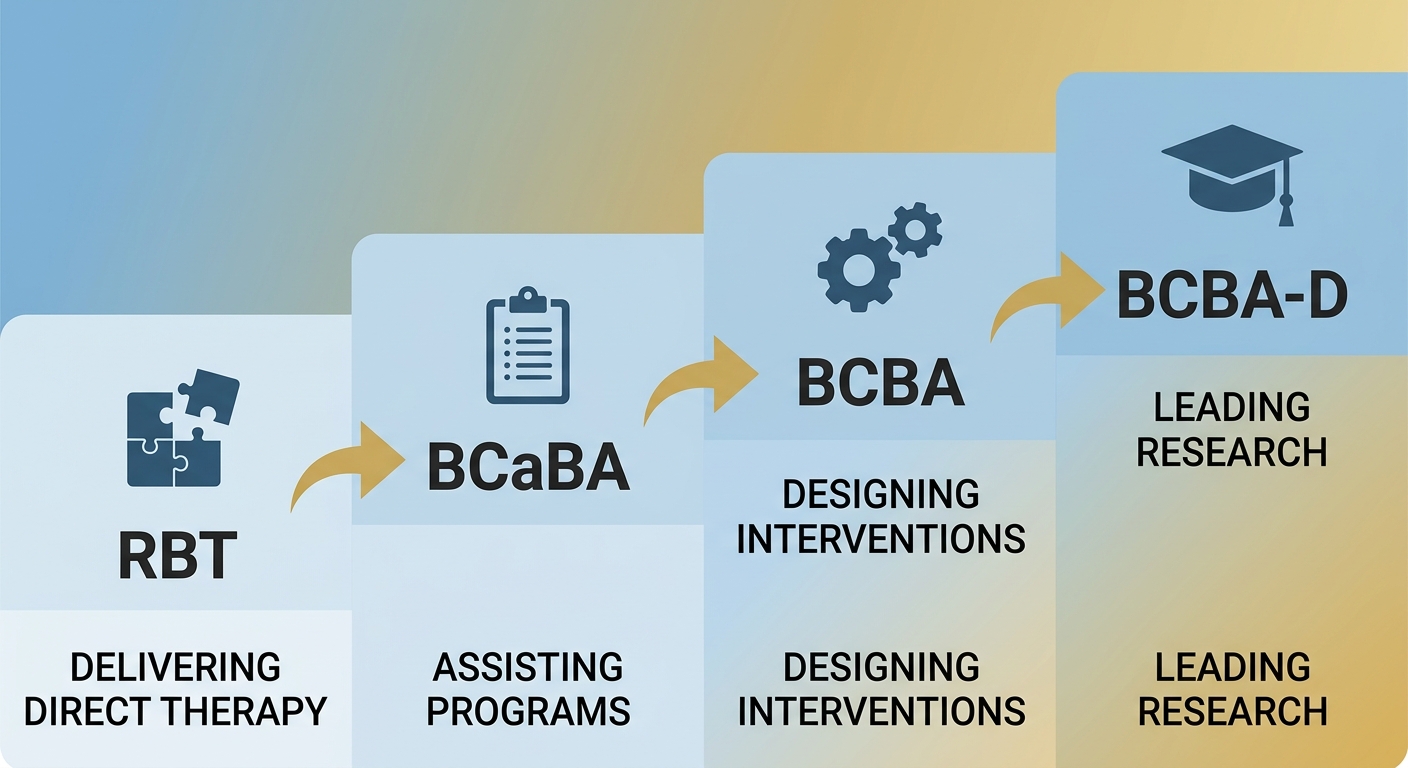
The roles of an RBT and BCaBA are often where the heart of daily, one-on-one therapy happens, with these professionals working directly with children under the guidance of a BCBA. A BCBA takes on a larger-scale responsibility, designing the individualized, results-driven programs that RBTs and BCaBAs implement. This is where your journey can evolve from direct care to program management, shaping not just individual sessions but the entire course of a family's treatment plan.
For those who wish to push the boundaries of the field even further, the BCBA-D, or doctoral designation, represents the pinnacle of the profession. This role moves beyond clinical supervision into advanced research, academic instruction, and high-level program development. The long-term trend in bcba salary trends clearly reflects this pyramid of responsibility, with each step up the career ladder bringing a significant increase in earning potential. Similarly, the momentum behind in bcba job growth is undeniable, with demand surging across schools, clinics, and in-home settings, as found in industry demand reports.
Trayectoria profesional de BCBA en análisis de comportamiento aplicado
This steady rise in both need and compensation points to a career that is not just stable, but deeply dynamic. Your progression can follow a natural rhythm, from earning your initial certification to mentoring the next generation of practitioners. As you consider this path, remember that it begins with a single, foundational step: meeting the initial academic and practical benchmarks set by the BACB. The roles and rewards we've outlined are the framework for a future where your expertise creates first moments and family smiles everywhere.
BCBA Job Growth and Salary Trends Across the U.S.
Beyond certification, the career outlook for BCBAs is exceptionally bright. The BCBA career outlook is remarkably strong, with employment for behavior analysts projected to grow much faster than the average for all occupations over the next decade. We're seeing extraordinary demand across school districts, early intervention programs, and private clinics nationwide, creating a landscape where BCBA job growth translates into real opportunities. For families and professionals alike, understanding these bcba salary trends helps paint a clear picture of where the field is heading and why pursuing this certification is such a meaningful career decision. As we at All About ABA can attest from our work across multiple states, the need for qualified, compassionate behavior analysts has never been greater.
National Job Growth Projections for BCBAs
The numbers tell a compelling story. According to Bureau of Labor Statistics projections, employment of behavior analysts is expected to surge 22 percent from 2022 to 2032, a rate dramatically outpacing the national average for all occupations. This expansion mirrors the increasing recognition of Applied Behavior Analysis as an essential therapeutic approach in special education settings, where school districts are actively recruiting Board Certified Behavior Analysts to support students with autism and related developmental needs. Early intervention programs represent another significant growth vector, as research consistently demonstrates that starting ABA services at a young age produces the most impactful outcomes.
Private clinics and in-home service providers, including our own centers from Scottsdale to Atlanta, are expanding their clinical teams to meet this rising demand. The BACB certificant registry has grown substantially, yet the supply of qualified BCBAs still struggles to keep pace with employer needs. For anyone considering this career path, the employment projections suggest sustained opportunity well into the next decade. We find that professionals who embrace child-led, naturalistic approaches are especially well positioned to thrive in this expanding field.
Regional Salary Variations: North Carolina and Beyond
Salary landscapes for BCBAs vary considerably depending on geography, and bcba salary trends reveal that cost-of-living context matters just as much as the raw numbers. In North Carolina, where All About ABA maintains a strong presence in Charlotte, BCBAs can expect average earnings ranging from $68,000 to $82,000 annually. Compare this with California's $80,000 to $100,000 range, and the headline figures might suggest the West Coast is the clear winner. But when we factor in the cost-of-living index, North Carolina's 96.2 versus California's 135.6, the real-world purchasing power shifts meaningfully in favor of the Tar Heel State. We believe that quality of life and financial sustainability go hand in hand, and states with below-average living costs often provide the most attractive overall packages for behavior analysts.
The table below draws on BACB salary survey data and Bureau of Labor Statistics employment projections to offer a broader comparison across key states where demand is particularly strong.
| State | Average BCBA Salary | Projected Growth Rate | Cost of Living Index |
|---|---|---|---|
| North Carolina | $68,000 – $82,000 | 22% | 96.2 (below national average) |
| Texas | $70,000 – $85,000 | 25% | 91.5 (below national average) |
| California | $80,000 – $100,000 | 18% | 135.6 (above national average) |
| New Jersey | $75,000 – $90,000 | 20% | 119.1 (above national average) |
| Georgia | $65,000 – $78,000 | 24% | 93.4 (below national average) |
| Arizona | $67,000 – $80,000 | 26% | 95.2 (below national average) |
What stands out most from this data is how states with lower cost-of-living indexes, including North Carolina, Texas, Georgia, and Arizona, offer competitive real incomes that often surpass what BCBAs can expect in higher-cost regions. For instance, while New Jersey salaries appear higher on paper at $75,000 to $90,000, the elevated cost-of-living index of 119.1 means that an Arizona BCBA earning $67,000 to $80,000 may enjoy comparable or even greater day-to-day financial comfort. The projected growth rates further reinforce where the most dynamic job markets are emerging, with Arizona leading at 26 percent and Texas close behind at 25 percent. We encourage BCBAs evaluating career opportunities to weigh salary figures against local living costs, alongside considerations like community, climate, and proximity to family support networks.
Factors Driving Demand in ABA Therapy
Several converging forces are propelling the demand for BCBAs to unprecedented levels. Insurance mandates represent the most significant structural driver, as state-level legislation increasingly requires health plans to cover ABA services for autism treatment. This has unlocked access for families who previously could not afford therapy, dramatically expanding the client base that providers serve. Simultaneously, greater autism awareness and improved diagnostic practices have led to the current understanding that approximately 1 in 36 children are identified with autism spectrum disorder, creating a corresponding need for qualified behavior analysts.
School district requirements add another powerful layer of demand, as Individualized Education Programs increasingly specify ABA-based supports that necessitate BCBA oversight. We are also witnessing meaningful expansion of services into adult populations, moving beyond the traditional early intervention focus to address vocational skills, community integration, and independent living for individuals across the lifespan. Organizations like All About ABA, with locations across seven states including our centers in Georgia, North Carolina, and Arizona, are actively creating new BCBA roles to meet this multifaceted demand. The growing recognition of behavioral therapy as a proven intervention has fueled demand for Board Certified Behavior Analysts, and we are proud to be part of a field that delivers such meaningful, results-driven outcomes for children and families. With this demand in mind, let's explore how to begin your BCBA journey with All About ABA.
Salary data derived from BACB salary survey and Bureau of Labor Statistics employment projections. Cost-of-living indexes based on national average baseline of 100.
Practical Steps to Launch Your BCBA Career
If you’re exploring what comes next in your professional journey, the BCBA career outlook is filled with meaningful opportunities to make a real difference. For those who are passionate about supporting children and families through evidence-based practices, we’re excited to guide you through the practical steps to get started. With the growing demand for Board Certified Behavior Analysts, now is a wonderful time to build a career rooted in compassion and clinical excellence.
Understanding BCBA Certification Requirements
Your first step toward certification is completing a master’s degree in applied behavior analysis, education, or psychology that includes a verified course sequence approved by the Behavior Analyst Certification Board (BACB). According to the Behavior Analyst Certification Board (BACB), this coursework is the bedrock of your clinical training and ensures you are prepared for ethical, effective practice. You must also pass the BACB BCBA exam, a comprehensive assessment of your knowledge in behavior analytic principles. If you plan to practice in Texas, be aware that the state requires an additional behavior analysis license from the Texas Behavioral Health Executive Council, which supplements your national credential.
The following table breaks down the three primary certification routes so you can choose the one that best matches your background and professional goals.
| Pathway | Degree Required | Supervised Hours | Exam | Typical Duration |
|---|---|---|---|---|
| Traditional Master's with University Practicum | Master's in ABA or related field with ABA coursework | 1,500 – 2,000 hours (practicum included) | BACB BCBA Exam | 2.5 – 3 years (including master's) |
| ABAI Verified Course Sequence (VCS) with Independent Supervision | Master's in any field + ABA graduate certificate from VCS program | 2,000 hours (independently arranged supervision) | BACB BCBA Exam | 1.5 – 2 years (certificate + fieldwork) |
| Alternate Pathway (Existing Related Master's) | Existing master's in education, psychology, speech, etc. + ABA course sequence | 1,500 – 2,000 hours (depending on degree alignment) | BACB BCBA Exam | 1 – 1.5 years (coursework + fieldwork) |
Each pathway has its own timeline and structure, and none is inherently superior to the others. The right choice depends on your existing academic credentials, your preferred learning style, and the type of mentorship you hope to receive. Whether you pursue an intensive university-based practicum or a flexible, independently supervised fieldwork experience, our team encourages you to select the route that aligns with your personal circumstances and long-term aspirations.
Building Experience in ABA Therapy
Once your coursework is underway, the next critical component is completing your supervised fieldwork. The BACB offers two options: a concentrated supervised fieldwork track requiring 1,500 hours, or a standard track of 2,000 hours. Regardless of the path, you must receive supervision for at least 5% of your total hours each month from a qualified BCBA supervisor, and you will need to carefully document your activities to meet BACB standards. To gain the most enriching experience, we recommend seeking placements that offer a diverse caseload. You might explore opportunities in specialized ABA clinics, public school districts, or private practices. For example, our multiple locations, including centers in New Jersey, Indiana, and North Carolina, provide rich environments where aspiring BCBAs can learn to implement individualized, play-based programs.
Quality supervision is about more than just ticking a box. Look for a mentor who will challenge you to think critically, model compassionate care, and provide constructive feedback on your clinical skills. Working across different settings—from one-on-one home sessions to group social skills programs—will build your confidence and prepare you for the multifaceted role of a BCBA. Remember, this period is your chance to translate theory into practice, and every hour of observation and hands-on intervention brings you closer to leading Your Family’s journey toward meaningful progress.
Navigating the Job Market: State-by-State Guidance
As you approach certification, navigating the job market becomes the next exciting hurdle. Start by connecting with your state’s ABA association and attending regional conferences to build relationships with experienced professionals. Many BCBA job growth reports indicate a sustained increase in demand for behavior analysts, and BCBA salary trends suggest competitive compensation packages for newly certified clinicians. When you prepare for interviews, be ready to discuss behavioral intervention plans with concrete examples from your fieldwork and to answer situational questions about ethics and family collaboration. If you are targeting a role in a specific state, such as Texas, ensure you have secured the state’s additional licensure to practice legally.
As you explore opportunities, you may consider connecting with ABA agencies in Atlanta, Georgia for in-person roles that allow you to immerse yourself in a vibrant clinical community. We believe in creating a warm and supportive space where every need is heard, whether you’re a family seeking services or a clinician just beginning your path. With these steps in mind, you are ready to embark on your BCBA journey and make a meaningful impact in the lives of children and families.
Advanced Career Strategies for Experienced BCBAs
When looking at the bcba carear outlook, specialization is one of the most effective ways to move you career forward. As a seasoned professional, you already understand the fundamentals of behavior analysis, and now you can build on that foundation by focusing on a specific population, setting, or methodology. We're here to help you navigate those possibilities with confidence, so you can create the career trajectory that feels right for you and your family.
The following table summarizes four common specialization paths and the salary premiums often associated with each, based on industry data.
| Specialization | Focus Population | Key Skills | Average Salary Premium |
|---|---|---|---|
| Early Intervention | Infants and toddlers (0–3) with developmental delays | Naturalistic teaching, parent coaching, developmental assessment | $5,000 – $10,000 above base |
| School-Based ABA | Students with autism and related disabilities (ages 3–21) | IEP collaboration, functional behavior assessment, classroom consultation | Comparable to base; more stable hours |
| Clinical/Private Practice | Children and adults in clinic or home settings | Supervision, clinical case management, marketing | $10,000 – $20,000 above base |
| Organizational Behavior Management (OBM) | Corporate and organizational teams | Performance analysis, training design, leadership coaching | $15,000 – $30,000 above base |
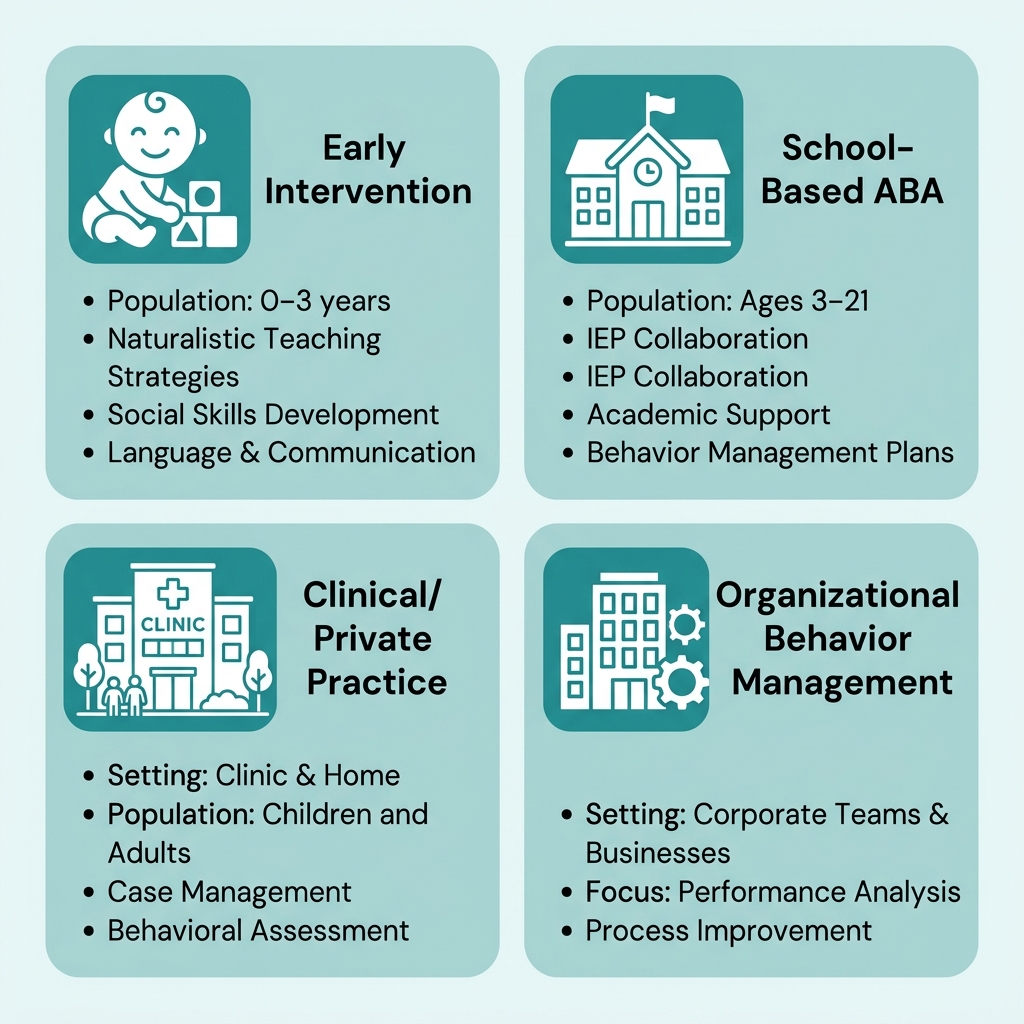
Early Intervention centers on infants and todlers from 0 to 3 who show developmental delays, and it emphasizes naturalistic teaching, parent coaching, and developmental assessment. The focus is on using a child-led approach in familiar environments, which often allows for rapid and meaningfull progress during a critical developmental window. According to the Behavior Analyst Certification Board (BACB), professionals in this area often see a premium of $5,000 to $10,000 above the BCBA base. School-Based ABA serves students with autism and reloted disabilities from ages 3 to 21. This setting requires strong skills in IEP collaboration and functional behavior assessments. While the salary is generally comparable to the base, many professionals value the more predictable school hours, which can offer a balence that supports family life. Clinical/Private Practice works with both children and adults in clinic or home settings. Success here demands strong supervision, clinical case management, and even marketing skills. bcba salary trends show that this path tends to bring a premium of $10,000 to $20,000 above the base, reflecting the added responsibilities of running a practice. Organizational Behavior Management (OBM) applies behavioral principles to corporate and organizational teams, a fast-growing area that draws on performance analysis, training design, and leadership coaching. This specialization often comands the highest premium at $15,000 to $30,000 above the base, and it illustrates the broader bcba job growth that extends well beyond autism services and into mainstream business settings.
Visualización de trayectorias de especialización en ABA
To move into one of these specializations, we recomend pursuing BACB-approved continuing education courses and seeking out mentorship or supervisory roles within you're choosen area. The demand for experienced BCBAs continues to rise, and focusing you're skills is a proven way to carv out a career path that is both rewarding and sustainable. Each journey looks different, and we're here to suport you as you explore the next step that feels right for you.
Common Questions About BCBA Career Prospects
Once you understand the role, you may wonder about the BCBA career outlook. We often hear questions about job opportunities, earning potential, and where certified analysts work, and we're pleased to share some insights.
"What is the job outlook?" BCBA job growth is projected to be faster than average according to the U.S. Bureau of Labor Statistics. Rising autism diagnosis rates and insurance mandates for ABA therapy are creating continuous demand, making certified analysts central to clinical care, much like our team at All About ABA.
"What about salary?" BCBA salary trends show a range that can vary by setting. In our experience across clinics and in-home programs, earnings typically fall between $55,000 and $85,000 annually, with potential for higher pay in supervisory roles or as an independent contractor.
"Where do BCBAs work?" Settings include in-home therapy, school systems, clinic-based programs, and even organizational behavior management. This versatility means the certification applies beyond autism, opening doors to diverse and meaningful work that helps individuals develop essential skills.
These prospects make BCBA certification an attractive path for many. After all, we're all about you—and your career matters to us, because when you grow, the families you serve benefit from your passion and expertise.
Start Your BCBA Career Journey with Confidence
Choosing a career path is a meaningful decision, and at All About ABA, we understand the importance of finding an environment where you can truly make a difference. Our team is built on a foundation of passionate professionals dedicated to providing results-driven, naturalistic, child-led therapy. We create a warm and supportive space where every need is heard and every step is taken with care — because your journey matters. When you join a community committed to clinical excellence and family integration, you're not just starting a job; you're becoming part of a team that celebrates Promoting First Moments and Family Smiles Everywhere. Step forward with the confidence that you can build a fulfilling career while helping children reach their full potential.